2026-02-17 京都大学
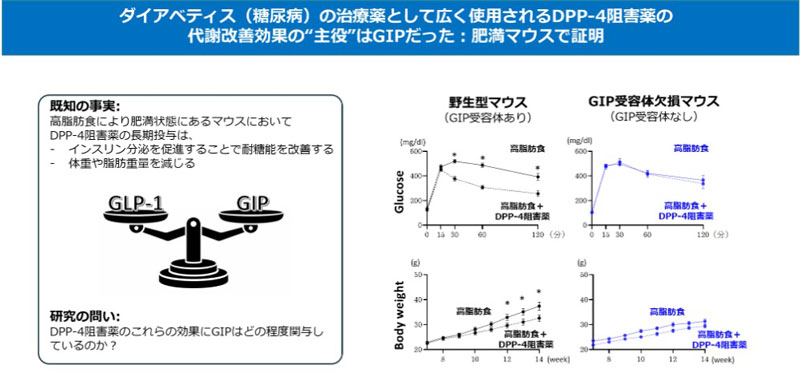
DPP-4阻害薬の長期投与による血糖改善効果、体重増加抑制効果には、GLP-1でなく、GIPが不可欠であることを高脂肪食による肥満マウスにおいて証明。
<関連情報>
- https://www.kyoto-u.ac.jp/ja/research-news/2026-02-17-0
- https://www.kyoto-u.ac.jp/sites/default/files/2026-02/web_2602_Yabe-e43adf90971597e0fab52f5b48150f01.pdf
- https://onlinelibrary.wiley.com/doi/10.1111/jdi.70252
内因性GIPシグナル伝達はマウスにおけるDPP-4阻害剤による代謝制御に不可欠である Endogenous GIP signaling is indispensable for DPP-4 inhibitor-mediated metabolic control in mice
Saki Kubota-Okamoto, Sodai Kubota, Hiromi Tsuchida, Yanyan Liu, Seiya Banno, Toshinori Imaizumi, Taro Fujisawa, Yoshihiro Takahashi, Takehiro Kato, Yukio Horikawa, Katsumi Iizuka, …
Journal of Diabetes Investigation Published: 03 February 2026
DOI:https://doi.org/10.1111/jdi.70252
ABSTRACT
Aims/Introduction
Dipeptidyl peptidase-4 (DPP-4) inhibitors enhance circulating levels of biologically intact incretins, yet the relative contribution of glucose-dependent insulinotropic polypeptide (GIP) to their metabolic effects remains incompletely understood. While glucagon-like peptide-1 (GLP-1) has long been emphasized in incretin biology, emerging evidence suggests important physiological roles for GIP. This study investigated whether endogenous GIP signaling is indispensable for the glucose-lowering and anti-obesity effects of DPP-4 inhibition.
Materials and Methods
Male Gipr+/+ and Gipr-/- mice were treated with anagliptin or linagliptin under normal diet or high-fat diet (HFD) conditions. Glucose tolerance, insulin secretion, incretin levels, body weight, and adiposity were assessed. To confirm GLP-1 pathway integrity, dulaglutide was administered to a subset of animals.
Results
DPP-4 inhibition significantly improved glucose tolerance and attenuated body-weight gain in HFD-fed Gipr+/+ mice, without affecting food intake. These effects were abolished in Gipr-/- mice, despite similar elevations in circulating biologically intact GIP and GLP-1. Under normal diet, DPP-4 inhibitors enhanced early-phase insulin secretion and lowered glucose levels in Gipr+/+ mice, but not in Gipr-/- mice. Importantly, dulaglutide restored glucose-lowering effects in Gipr-/- mice, confirming preserved GLP-1 receptor function.
Conclusions
Endogenous GIP signaling is essential for both glucose-lowering and anti-obesity actions of DPP-4 inhibitors in mice. GLP-1 elevation alone is insufficient to compensate for GIP receptor deficiency. These findings refined the mechanistic understanding of DPP-4 inhibitors, highlighted the physiological importance of GIP, and suggested context-dependent metabolic actions of incretins.