2026-03-09 バース大学
<関連情報>
- https://www.bath.ac.uk/announcements/new-research-brings-hope-for-earlier-detection-of-pre-eclampsia/
- https://link.springer.com/article/10.1186/s13059-026-03944-z
内因性レトロウイルス要素LTR8BとMER65はPSG9の調節を再配線し、栄養芽層の合胞体形成と子癇前症のリスクを制御する Endogenous retroviral elements LTR8B and MER65 rewire PSG9 regulation to control trophoblast syncytialization and pre-eclampsia risk
Manvendra Singh,Yuliang Qu,Amit Pande,Julianna Zadora,Florian Herse,Martin Gauster,Xuhui Kong,Rongyan Zheng,Rabia Anwar,Katarina Stevanovic,Ralf Dechend,Marie Cohen,Attila Molvarec,Jichang Wang,Miriam K. Konkel,Bin Zhang,Cedric Feschotte,Gabriela Dveksler,Sandra M. Blois,Laurence D. Hurst & Zsuzsanna Izsvák
Genome Biology Published:09 March 2026
DOI:https://doi.org/10.1186/s13059-026-03944-z
Abstract
Background
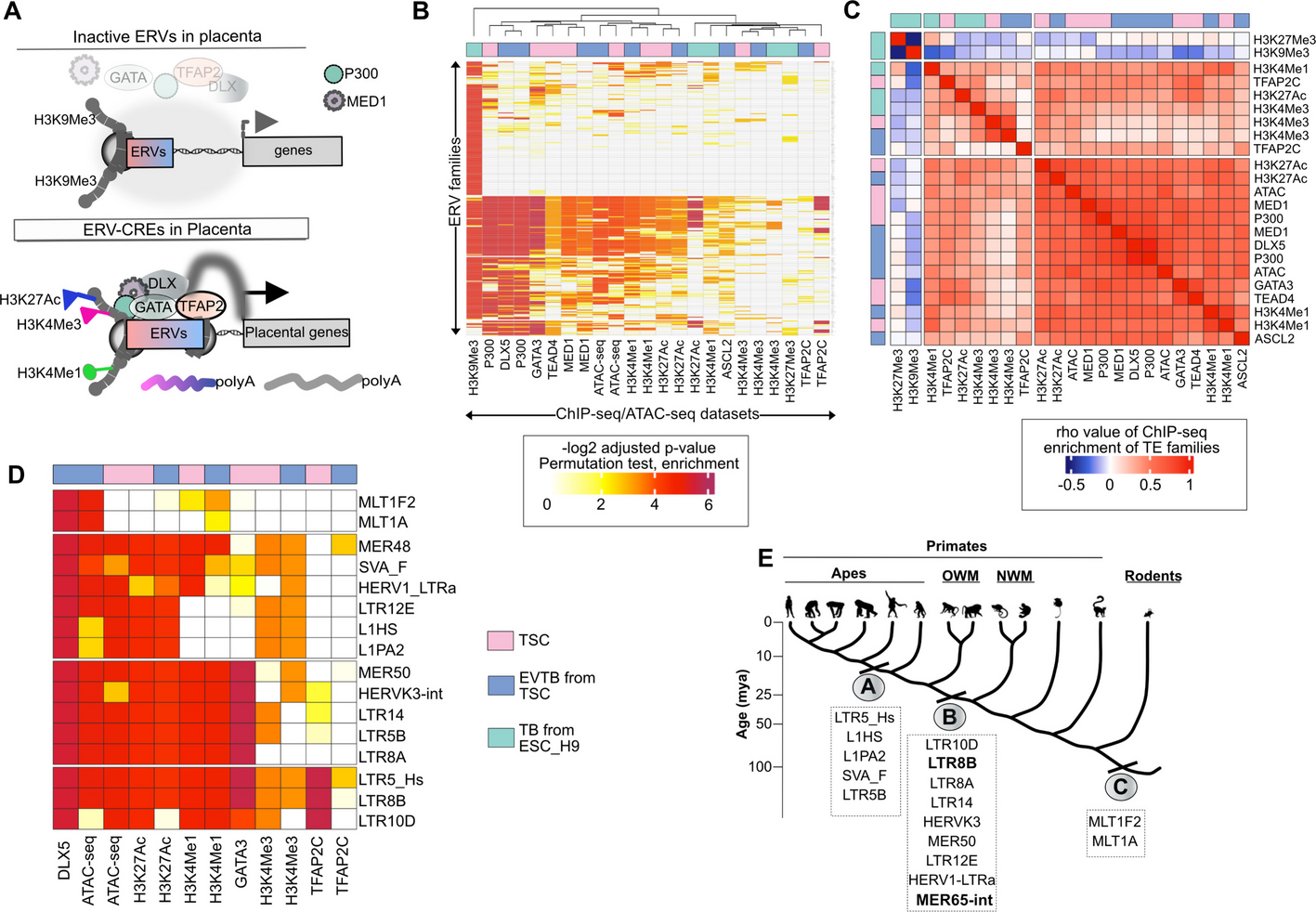
Understanding the causes of the exceptional rate of evolution of the mammalian placenta is likely to aid the understanding of placental development and the etiology of the human-specific pregnancy disorder pre-eclampsia (PE). As retroelements are often lineage-specific and known to be co-opted for placental function, here we consider the binding of the transcription factors GATA3 and DLX5 to retroelements. These factors are dysregulated in pre-eclampsia, as are their downstream consequences.
Results
We identify retrovirus-derived LTR8B as a placentally-relevant cis-regulatory element (CRE), not least within the PSG array, a primate-specific genomic region that exhibits high intraspecies variability. LTR8B at PSG9 is particularly influential affecting other PSG family members. Moreover, unique among PSGs, PSG9 produces both secreted and membrane-anchored isoforms. The retroelement MER65-int provides alternative polyA signals that enable the evolution of secreted PSG variants by truncating the ancestral CEACAM protein’s transmembrane domain. Functional characterization finds that LTR8B/PSG9 regulates the differentiation of multinucleated trophoblasts (syncytialization) and, like chorionic gonadotropin and syncytin1, determines the identity of syncytiotrophoblasts. Notably, PSG9 is the most upregulated PSG in PE, with levels correlated with GATA3 and DLX5 levels.
Conclusions
Retroelements contribute to the structural and expression evolution of PSG genes, facilitating lineage-specific placental evolution. The LTR8B/PSG9 regulatory network plays a central role in syncytiotrophoblast differentiation. Given the association between DLX5/GATA3 dysregulation and elevated PSG9 levels, along with PSG9’s expression in the first trimester, PSG9 shows potential as a predictive biomarker for preeclampsia.