2026-03-16 東京大学,北海道大学
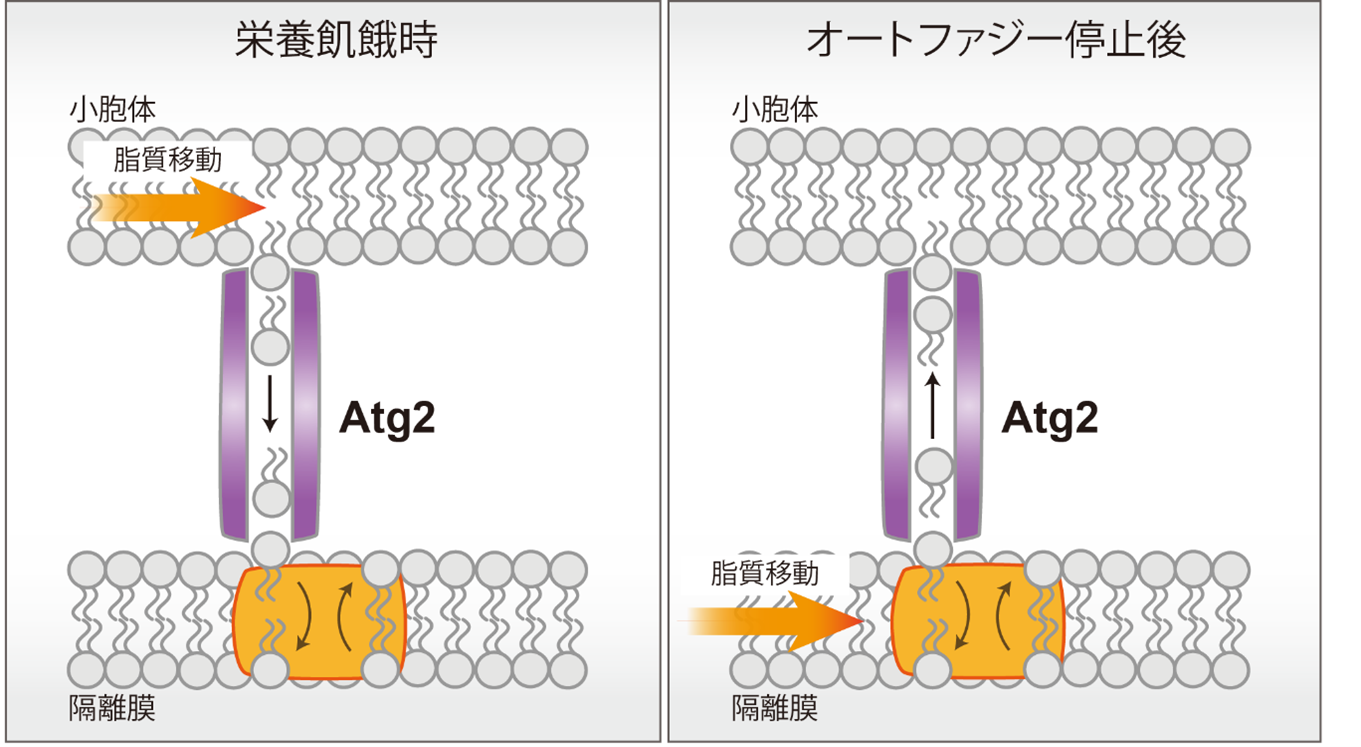
図1:双方向の脂質移動
<関連情報>
- https://www.k.u-tokyo.ac.jp/information/category/press/0029355.html
- https://rupress.org/jcb/article-abstract/225/5/e202506039/281547/Reversible-one-way-lipid-transfer-at-ER?redirectedFrom=fulltext
Atg2を介したER-オートファゴソーム膜接触部位における可逆的な一方向脂質転送
Reversible one-way lipid transfer at ER–autophagosome membrane contact sites via Atg2
Li Hao,Tomoki Midorikawa,Yuta Ogasawara,Takuma Tsuji,Takuma Kishimoto,Yutaro Hama,Huichao Lang,Nobuo N. Noda,Kuninori Suzuki
Journal of Cell Biology Published:March 10 2026
DOI:https://doi.org/10.1083/jcb.202506039
Bridge-like lipid transfer proteins (LTPs) contain a repeating β-groove domain and long hydrophobic grooves that act as bridges at membrane contact sites (MCSs) to efficiently transfer lipids. Atg2 is one such bridge-like LTP essential for autophagosome formation, during which a newly synthesized isolation membrane (IM) emerges and expands through lipid supply. However, studies on Atg2-mediated lipid transfer are limited to in vitro studies due to the lack of a suitable probe for monitoring phospholipid dynamics in vivo. Here, we characterized the lipophilic dye octadecyl rhodamine B (R18), which internalizes and labels the endoplasmic reticulum (ER) in a manner that requires flippases and oxysterol-binding protein–related proteins. Using R18, we demonstrated phospholipid transfer from the ER to the IM during autophagy in vivo. Upon autophagy termination, our data suggested the reversible phospholipid flow from the IM to the ER in response to environmental changes. Our findings highlight the critical role of bridge-like LTPs in MCS-mediated phospholipid homeostasis.