2026-03-25 東北大学
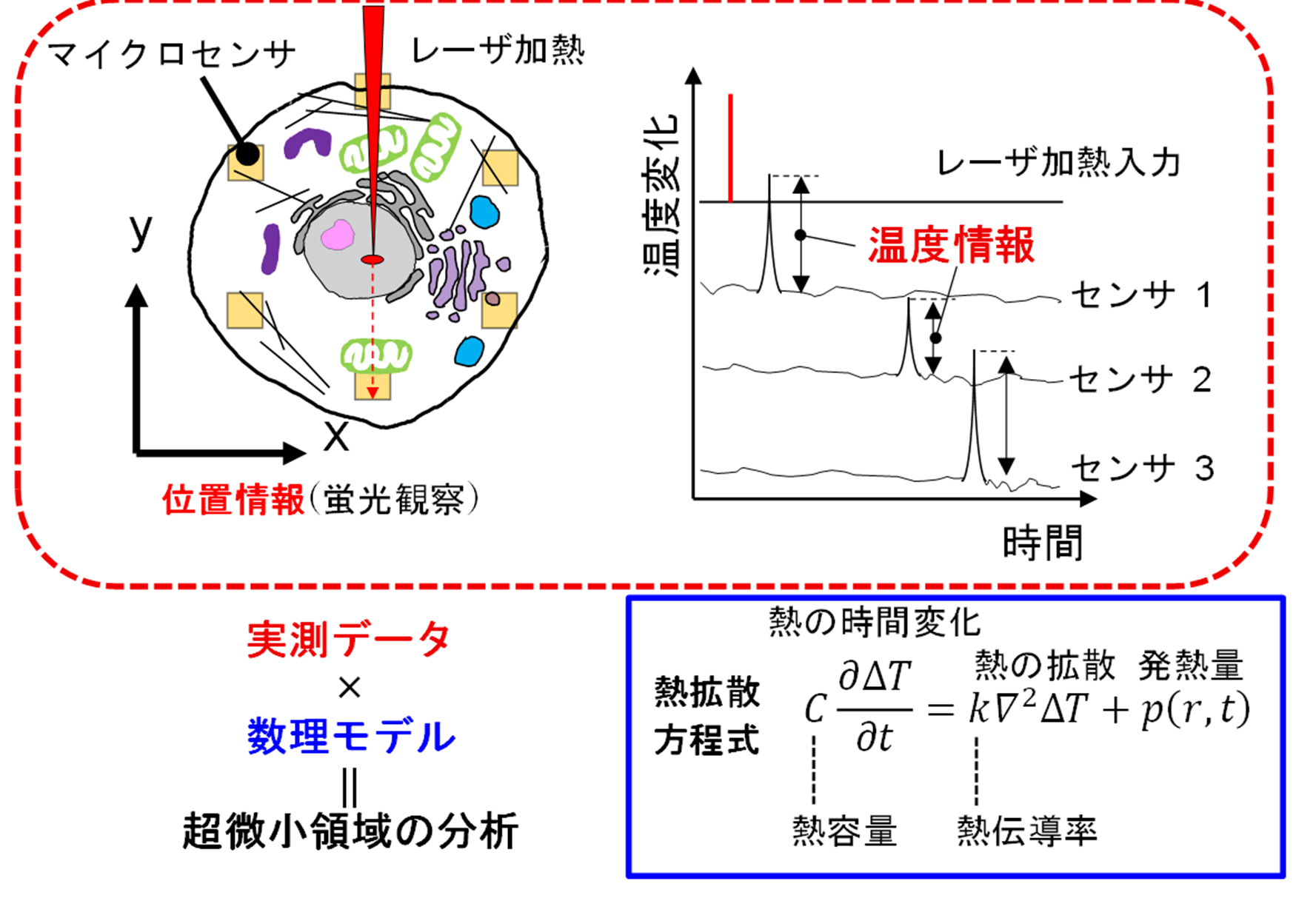
図1. 実測データと数理モデルを融合した分析技術の概要。マイクロ温度センサアレイで取得した温度情報と、蛍光観察で取得したオルガネラの位置情報を熱拡散方程式に組み込み、オルガネラの熱伝導率を推定する。
<関連情報>
- https://www.tohoku.ac.jp/japanese/2026/03/press20260325-01-cell.html
- https://www.tohoku.ac.jp/japanese/newimg/pressimg/tohokuuniv-press20260325_01_cell.pdf
- https://www.sciencedirect.com/science/article/pii/S2666053926000287
透明マイクロサーミスタアレイにより、生細胞内の細胞小器官レベルの熱伝導率推定が可能に Transparent Micro-Thermistor Array Enables Organelle-Resolved Thermal Conductivity Estimation in Living Cells
Naoki Inomata, Kaito Suzuki
Sensors and Actuators Reports Available online: 10 March 2026
DOI:https://doi.org/10.1016/j.snr.2026.100461
Highlights
- A transparent micro-thermistor array enables multisite cellular temperature sensing.
- Simultaneously, the sensor array is compatible with fluorescence imaging of organelle structures.
- Inverse thermal analysis allows estimation of organelle-specific thermal conductivities Temperature-dependent thermal conductivities reflect structural heterogeneity in cells.
Abstract
Quantitative determination of heat flow through subcellular structures is essential for understanding intracellular heat transport and the thermophysical properties of living cells. However, organelle-resolved thermal properties cannot be measured because existing intracellular thermometry techniques either perturb cells with exogenous probes or lack the spatial resolution required for organelle-scale analysis. To overcome these limitations, we developed a transparent vanadium dioxide (VO₂) micro-thermistor array that enables simultaneous, multisite temperature measurements in one to several adherent cells while maintaining full compatibility with fluorescence microscopy. This micro-thermistor array uniquely integrates transparent VO₂ thermistors with fluorescence-compatible microfabrication, enabling the estimation of organelle-resolved thermal conductivity through thermal-circuit-based inverse analysis. The six-element array, fabricated on a quartz substrate with indium tin oxide (ITO) electrodes, exhibited a temperature coefficient of resistance of 1.51%°C⁻¹, temperature resolution of 8.8 m°C, and sufficient visible transmittance for confocal fluorescence imaging. By integrating dynamic temperature responses under localized IR laser heating with three-dimensional fluorescence images of nuclei, mitochondria, cytoplasm, and other organelles, we constructed a thermal-circuit model and performed inverse analysis to estimate the thermal conductivities of individual organelles. The resulting organelle-level conductivities reflected known intracellular organization, showed distinct temperature dependence at 25°C, 37°C, and 45°C, and yielded effective whole-cell thermal conductivities of 0.55–0.70 W m⁻¹ K⁻¹, consistent with previously reported single-cell values. These findings demonstrate that transparent micro-thermistor arrays function as probe-free sensors enabling organelle-resolved estimation of intracellular thermal properties, establishing a quantitative sensing platform for the systematic analysis of heat transport and thermoregulation in living cells.