2026-03-31 東北大学
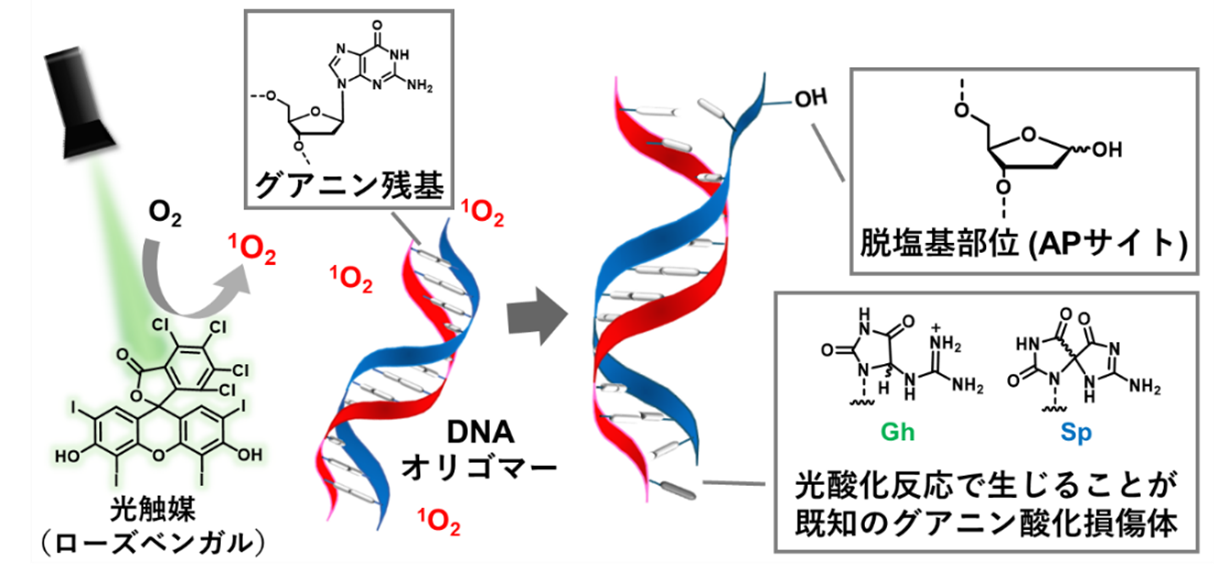
図1. 本研究の概要 光触媒による光酸化反応によって既知の酸化損傷体(Gh、Sp)に加え、脱塩基部位(APサイト)と呼ばれるDNA損傷が生じる現象を発見した。
<関連情報>
- https://www.tohoku.ac.jp/japanese/2026/03/press20260331-01-dna.html
- https://www.tohoku.ac.jp/japanese/newimg/pressimg/tohokuuniv-press20260331_01web_dna.pdf
- https://www.nature.com/articles/s42004-026-01979-8
一重項酸素を介したDNA中のア塩基部位の光触媒的生成 Singlet oxygen-mediated photocatalytic generation of abasic sites in DNA
Yuuhei Yamano,Kazumitsu Onizuka,Okan Altan,Madoka Sasaki,Ahmed Mostafa Abdelhady,Shigeki Sasaki & Fumi Nagatsugi
Nature Chemistry Published:20 March 2026
DOI:https://doi.org/10.1038/s42004-026-01979-8 Unedited version
Abstract
Oxidative stress factors such as light and inflammation are known to damage nucleic acids through various mechanisms. Guanine, among the four canonical nucleobases, is particularly susceptible to oxidation, leading to the formation of oxidatively generated lesions such as 8-oxo-7,8-dihydroguanine (8-oxoG), spiroiminodihydantoin (Sp), and guanidinohydantoin (Gh). In this study, we now report an abasic (AP) site generation from guanine residue oxidation based on photocatalytic reactions. The study used Dickerson–Drew dodecamer DNA as the model oligo DNA for photocatalytic reactions, and the reactions were analyzed using denaturing polyacrylamide gel electrophoresis, matrix-assisted laser desorption ionization time-of-flight mass spectrometry, and ultra-performance liquid chromatography coupled with electrospray ionization mass spectrometry measurements. It was observed that guanine residues are converted into AP sites by reacting with singlet oxygen generated from the photocatalyst. Guanine residues with high solvent accessibility were found to be particularly reactive with singlet oxygen. Mechanistic investigations revealed that the photocatalytic generation of AP sites proceeds mainly via an 8-oxoG-independent mechanism. These findings are important for the design and development of photocatalyst-modified functional oligo probes and the understanding of their reactions.