2026-03-24 大阪公立大学
<関連情報>
- https://www.omu.ac.jp/info/research_news/entry-22972.html
- https://www.omu.ac.jp/assets/attachmentfile/attachmentfile-file-89961.pdf
- https://www.nature.com/articles/s41467-026-70516-x
異種オルガネラを利用するための一時的な分子キメラ現象 Transient molecular chimerism for exploiting xenogeneic organelles
Yuichiro Kashiyama,Moe Maruyama,Masami Nakazawa,Tsuyoshi Kagamoto,Hiroki Imanishi,Sayaka Yamamoto,Mio Inoue,Ryo Onuma,Goro Tanifuji,Hiroki Ashida,Noriko Inada,Koichiro Awai & Shin-ya Miyagishima
Nature Communications Published:24 March 2026
DOI:https://doi.org/10.1038/s41467-026-70516-x
Abstract
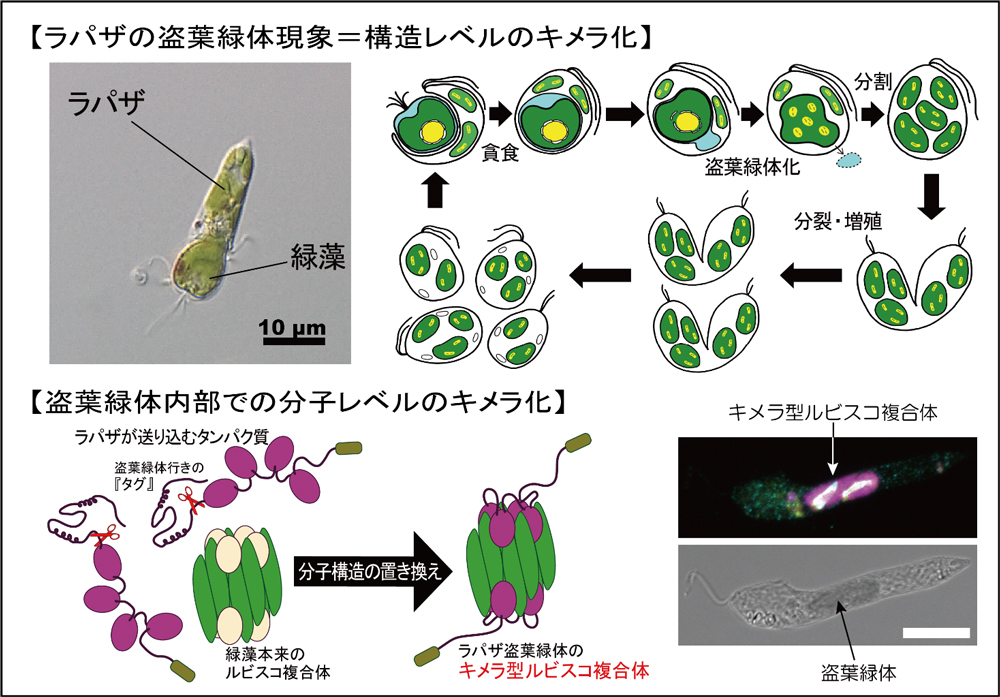
The symbiogenetic origin of organelles, such as chloroplasts, is established, and organelle genomes provide evidence of prokaryotic ancestry. Nevertheless, most organelle proteins are nuclear-encoded and function in concert with those expressed from the organelle genomes, representing constitutive molecular chimerism. The evolutionary forces generating chimerism have been widely discussed, but without much evidence. Here we provide biochemical evidence of transient molecular chimerism in nature, along with a possible mechanistic explanation for chimerism. In the flagellate, Rapaza viridis, nuclear-encoded proteins support photosynthesis in transient, xenogeneic chloroplasts (kleptoplasts) acquired from the green alga Tetraselmis sp. We focused on two putative kleptoplast-targeted proteins: a RuBisCO small subunit-like protein (RvRbcS-like) and a RuBisCO activase homologue. Immunofluorescence microscopy confirmed the kleptoplast localization of the proteins, and the knockdown and knockout experiments demonstrated impaired photosynthesis, particularly for RvRbcS-like. The unique carboxyl-terminal extension of the RvRbcS-like protein suggests that it has an additional role in pyrenoid reorganization, a key step in kleptoplast remodelling. Protein translocation into kleptoplasts requires rapid, de novo assembly of transport systems after each acquisition, unlike the constitutive chimerism of established organelles. This previously unreported phenomenon in eukaryotes positions R. viridis as a unique, genetically tractable model for investigating the molecular and evolutionary origins of organelles.