2026-04-10 京都大学
<関連情報>
- https://www.kyoto-u.ac.jp/ja/research-news/2026-04-10-5
- https://www.kyoto-u.ac.jp/sites/default/files/2026-04/web_2604_Murakami-64a1d9979a65400abc1ad3961ce47338.pdf
- https://onlinelibrary.wiley.com/doi/10.1111/jdi.70307
日本における耐糖能異常を有する人への新型コロナウイルス感染症(COVID-19)に伴う行動制限および制限緩和が、体組成と血糖コントロールに及ぼした影響:単施設観察研究 Impact of COVID-19 restrictions and their relaxation on body composition and glycemic control in individuals with glucose intolerance in Japan: A single-center observational study
Ami Kobayashi, Yamato Keidai, Takaaki Murakami, Ryo Tsukaguchi, Miharu Fujita, Keiko Wada, Daisuke Yabe
Journal of Diabetes Investigation Published: 09 April 2026
DOI:https://doi.org/10.1111/jdi.70307
ABSTRACT
Aims/Introduction
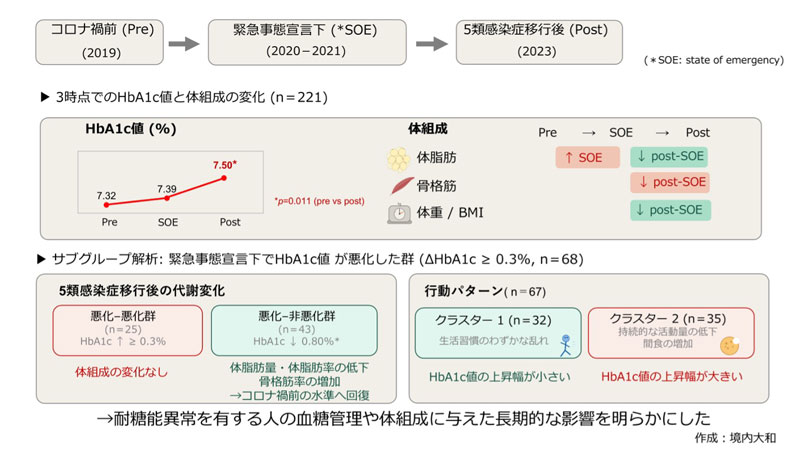
During the coronavirus disease 2019 (COVID-19) pandemic, Japan imposed voluntary-based restrictions under a state of emergency (SOE) from 2020 to 2021, and nationwide behavioral restrictions ended with its category 5 status in May 2023. The long-term metabolic impact and their behavioral adaptations of these restrictions and relaxation remain unclear in individuals with glucose intolerance (GI). This single-center observational study assessed changes in glycemic control, body composition, and lifestyle changes across the pre-SOE (2019), SOE (2020–2021), and post-SOE (2023) periods in outpatients.
Materials and Methods
We included 221 outpatients with GI who had complete data for glycated hemoglobin (HbA1c) and body composition in all three periods. Lifestyle changes were evaluated using a questionnaire at post-SOE period.
Results
HbA1c levels gradually increased, with a significant elevation post-SOE compared to pre-SOE. While body weight and BMI remained stable during the SOE, both decreased post-SOE. Fat mass increased during the SOE and thereafter decreased, whereas skeletal muscle mass decreased progressively. Among 68 individuals whose HbA1c worsened during the SOE, 25 experienced further deterioration post-SOE, whereas 43 showed improvements in both glycemic control and body composition. Clustering analysis of questionnaire responses in this subgroup identified two behavioral patterns. One cluster, marked by the combination of persistent reductions in physical activity and increased snacking, showed greater post-SOE HbA1c increases.
Conclusions
This study clarified long-term metabolic effects of COVID-19 restrictions with glycemic deterioration in individuals with GI. In exploratory analysis of those with HbA1c worsening during SOE, behavioral patterns were associated with post-SOE HbA1c changes.