2026-04-21 国立成育医療研究センター
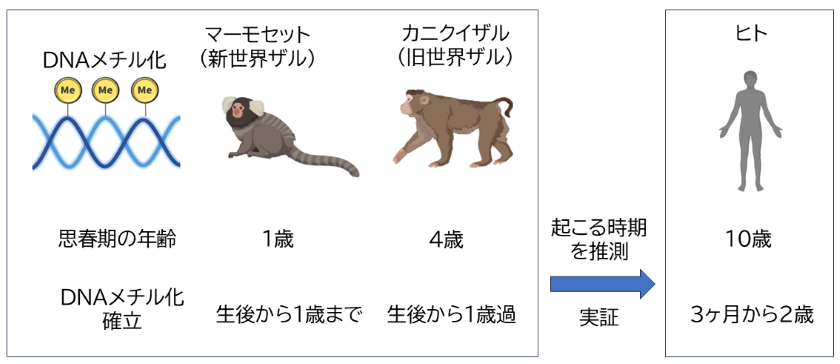
【図1:サルを活用して、男児の生殖細胞のDNA メチル化確立の時期を決定】
<関連情報>
霊長類の生殖細胞発生におけるDNAメチル化の確立 Establishment of DNA methylation during primate germ cell development
Kazuaki Kojima,Yi Li,Shin-ichi Tomizawa,Miho Kohara,Yuta Kuze,Takuya Sato,Toshinobu Ebata,Musashi Kubiura-Ichimaru,Mei Cao,Tatsuya Hattori,So Maezawa,Sofia B. Winge,Kristian Almstrup,Ryo Nakaki,Shinya Sato,Yohei Miyagi,Yataro Daigo,Takako Yoshioka,Yuichi Hasegawa,Yoshiaki Kinoshita,Taiju Hyuga,Kimihiko Moriya,Hideyuki Kobayashi,Laurence Baskin,… Toshiaki Watanabe
Nature Communications Published:08 April 2026
DOI:https://doi.org/10.1038/s41467-026-71405-z Unedited version
Abstract
DNA methylation is almost completely erased throughout the genome in primordial germ cells, and then reestablished during mammalian germ cell development. In this study, we demonstrate that in three primate species—marmosets, macaques, and humans–de novo methylation occurs postnatally in prospermatogonia in males and growing oocytes in females. In monkey prospermatogonia, de novo methylation is a prolonged process spanning 6 months to 1 year, primarily occurring within the first year after birth. In human testes, this process may occur more slowly over an extended period. Single-cell bisulfite sequencing analyses in spermatogonia of three species revealed that all genomic regions acquire DNA methylation gradually. However, DNA methylation levels increase faster in genic regions compared to intergenic regions. Unlike in mice, mitotic divisions occur during the establishment of methylation in prospermatogonia. The established methylation is likely maintained because maintenance methyltransferase DNMT1 is specifically expressed during the mitotic stage. Our findings show notable differences in the de novo DNA methylation processes in male germ cells between mice and primates.