2026-04-28 北海道大学,足寄動物化石博物館
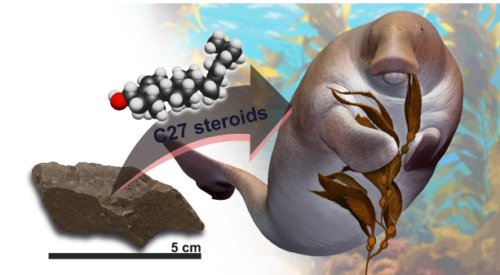
図 1.本研究の概略図:骨化石から抽出されたコレステロールなどから分かった食性。©Tatsuya Shinmura / Ashoro Museum of Paleontology
<関連情報>
- https://www.hokudai.ac.jp/news/2026/04/post-2269.html
- https://www.hokudai.ac.jp/news/pdf/260428_pr.pdf
- https://www.sciencedirect.com/science/article/abs/pii/S0031018226002725
北海道から産出したカイギュウ類化石の中に保存された脂質の炭素同位体比を用いた食性解析Paleodietary analysis based on stable carbon isotope ratios of lipids preserved in sirenian fossil bones from Hokkaido, Japan
Tatsuya Shinmura, Ken Sawada
Palaeogeography, Palaeoclimatology, Palaeoecology Available online: 18 April 2026
DOI:https://doi.org/10.1016/j.palaeo.2026.113809
Highlights
- Indigenous lipids could be identified from Miocene–Pliocene sirenian fossil bones.
- δ13C values of steroids and fatty acids in fossils are useful for dietary analysis.
- δ13C results are consistent with Metaxytherium feeding on seagrass.
- Lipid-based isotopic methods are effective for paleodietary studies of fossil bones.
Abstract
We analyzed the stable carbon isotope ratios (δ13C) of fatty acids (FAs) and sterols extracted from fossil sirenian bones (Metaxytherium, Dusisiren, and Hydrodamalis spissa) recovered from Miocene to Pliocene marine sediments in Hokkaido, Japan. FAs were detected in all specimens; however, based on their composition and isotopic characteristics, they are likely to include exogenous sources, including microbial lipids. In contrast, sterols such as cholesterol and its diagenetic derivatives extracted from the bones were interpreted as indigenous based on their compositions. The sterol δ13C values were − 13.7‰ for Metaxytherium (ca. 11 Ma), −20.5‰ for Dusisiren (9.2–7.3 Ma), and − 19.3‰ for Hydrodamalis spissa (4.7–3.7 Ma). These values were compared with those of the extant seagrass-feeding Dugong dugon (−8.9‰ to −10.3‰). The δ13C value of Metaxytherium was relatively close to that of D. dugon, consistent with a seagrass-dominated diet. In contrast, the substantially lighter values of Dusisiren and H. spissa are consistent with a diet dominated by seaweed such as kelp.