2026-05-01 琉球大学
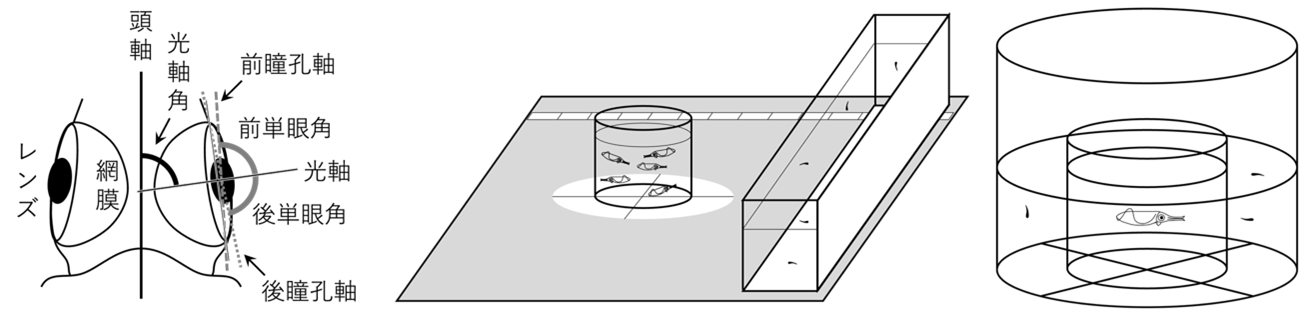
図.視力と視野を調べるための解剖学的手法と行動学的手法
左:レンズの大きさと網膜内の視細胞の密度から視力を推定し、レンズと網膜の位置関係から視野を推定した。
中央:イカとグッピーの間の距離とグッピーの大きさから視力を推定した。
右:グッピーに気づいた時点でのイカの頭の向きとグッピーの位置から視野を推定した。
<関連情報>
- https://www.u-ryukyu.ac.jp/news/77729/
- https://journals.biologists.com/jeb/article/229/8/jeb250437/371552/Camera-type-eye-specific-visual-ontogeny-in-squid
アオリイカにみるカメラ眼特有の視覚発達 Camera-type eye specific visual ontogeny in squid (Sepioteuthis lessoniana)
Chikatoshi Sugimoto,Shuhan Lei,Toru Ao,Yuma Sakurai,Xiumei Zhang,Yuzuru Ikeda
Journal of Experimental Biology Published:29 April 2026
DOI:https://doi.org/10.1242/jeb.250437
ABSTRACT
The well-developed vision of vertebrates possessing camera-type eyes is rapidly established during the early phases of life. Cephalopods, a group of mollusks, possess well-developed camera-type eyes similar to those of vertebrates. Although the anatomy of the cephalopod visual system has been studied as an example of convergent evolution between vertebrates and invertebrates, knowledge of their vision and ontogeny is limited. Therefore, this study focused on the squid Sepioteuthis lessoniana to anatomically and behaviorally trace the ontogeny of vision, which includes eye anatomy, visual acuity and visual field during the 2 months post-hatching, to examine whether there are commonalities in the ontogenic features of camera-type eyes. Visual acuity estimated behaviorally rapidly increased during the first 2 weeks post-hatching, whereas visual acuity estimated anatomically increased continuously during the post-hatching phase and was accomplished by increasing the lens diameter and decreasing the density of visual cells with the thickening of the rhabdomeric layer. In contrast to the difference of the ontogenic features of visual acuity between behavioral and anatomical examination, the visual field exhibited a remarkable increase during the first week post-hatching in both examinations and this occurred along with a change in the orientation of the eyeballs in the head region. These results highlight that the common ontogenic feature of cephalopod vision is comparable to that of vertebrate vision, and indicates a specific early survival strategy in cephalopods with a short life span and no overlapping generations.