2026-05-12 東京大学
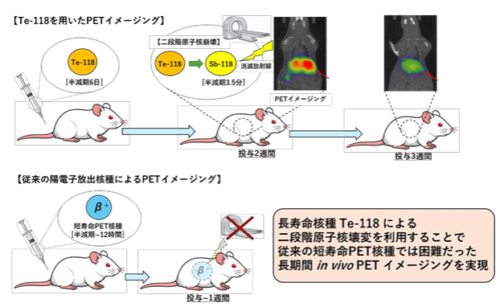
テルル-118 (Te-118)を用いた長期間PETイメージング
<関連情報>
テルル118を長期陽電子放出断層撮影のための新規放射性核種として利用する Tellurium-118 as a novel radionuclide for long-term positron emission tomography
Sotaro Miyao,Toshimitsu Momose,Masako Kawabata,Yuki Mitsuya,Atsuko Nakanishi Ozeki,Arisa Hayashi,Xindi Qiu,Yousuke Kanayama,Hiromitsu Haba,Izumi O. Umeda,Jaewoong Jang,Youichiro Wada,Nobuyoshi Akimitsu & Hiroyuki Takahashi
Scientific Reports Published:12 May 2026
DOI:https://doi.org/10.1038/s41598-026-46505-x
Abstract
Positron emission tomography (PET) is a powerful imaging modality that tracks positron-emitting radionuclides, enabling non-invasive and high-resolution visualization of biological targets and processes. However, conventional PET tracers possess short half-lives, which limits their utility for long-term pharmacokinetic studies of slow-clearing agents such as antibodies. To address this unmet need, we developed and evaluated tellurium-118 (118Te), a long-lived radionuclide (T₁/₂ = 6.0 days) that decays via electron capture to produce antimony-118 (118Sb), a short-lived positron emitter (T₁/₂ = 3.5 min). This decay cascade allows 118Te to function as an in vivo radionuclide generator, providing sustained positron emission from a single administration. We successfully produced 118Te and performed PET imaging with NEMA and Derenzo phantoms, confirming its PET images with sufficient spatial resolution. In vivo PET/CT imaging of mice following intravenous administration of 118Te revealed the persistence of PET signals in the abdominal region up to three weeks post-injection. Ex vivo biodistribution analysis confirmed the prolonged retention of radioactivity in abdominal organs, particularly the liver and spleen. These findings demonstrate the feasibility of 118Te as a long-lived PET radionuclide for extended molecular imaging. Its unique decay profile and sustained signal generation make it a promising candidate for longitudinal pharmacokinetic studies and radiotheranostic applications.