2026-052-13 大阪公立大学
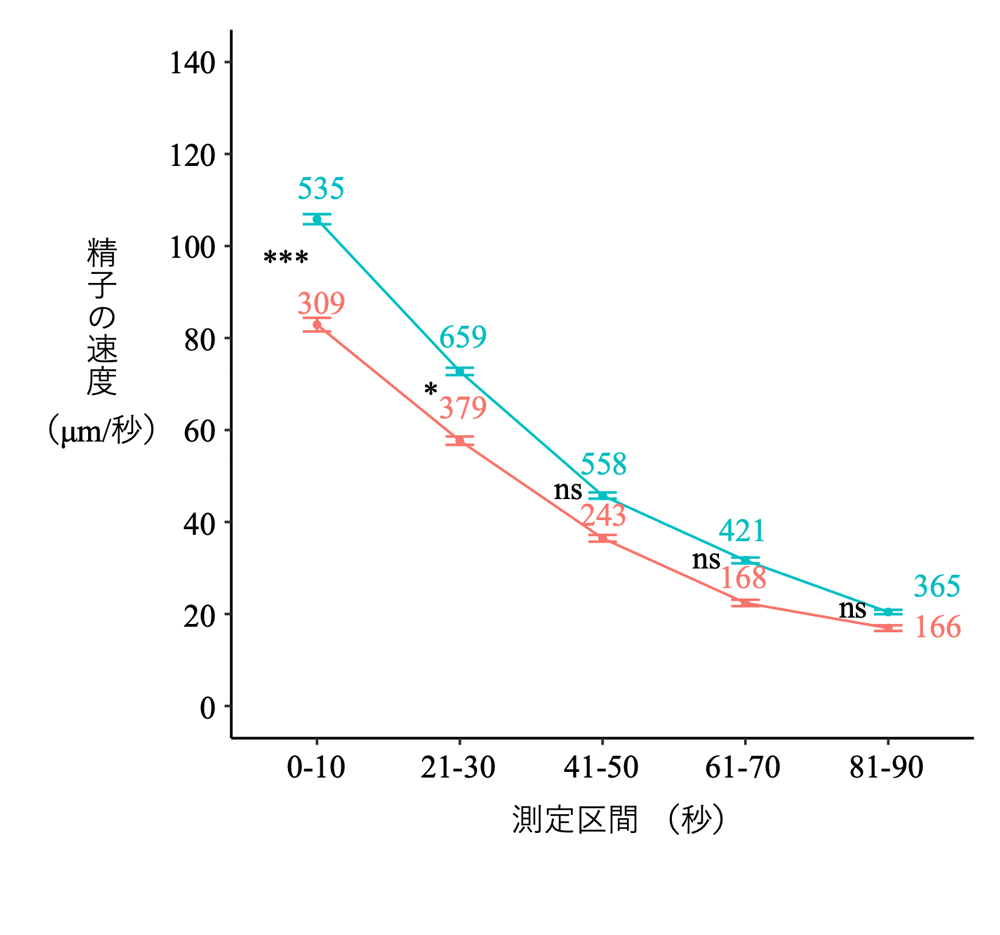
図3. 1回繁殖オス(水色)と連続繁殖オス(ピンク)における精子の速度の時間変化。点は平均、エラーバーは標準偏差、プロット上の数は計測した精子の数を示す。***は統計的に非常にはっきりとした差があること、*は差があること、nsは差がないことを示す。
<関連情報>
- https://www.omu.ac.jp/info/research_news/entry-23889.html
- https://link.springer.com/article/10.1007/s10164-026-00887-7
質的精子減少:メダカでは連続交尾により精子の初期速度が低下する Qualitative sperm depletion: successive mating reduces initial sperm velocity in medaka fish
Yuki Kondo,Takeshi Ito & Satoshi Awata
Journal of Ethology Published:16 April 2026
DOI:https://doi.org/10.1007/s10164-026-00887-7
Abstract
Sperm depletion, a reduction in male fertilization capacity through successive mating, has been extensively documented across animal taxa. However, research has predominantly focused on quantitative reductions in sperm while overlooking potential qualitative changes. In the present study, we investigated whether successive mating affects sperm velocity in medaka (Oryzias latipes), a model fish used for reproductive studies. We compared the sperm velocity between males that mated once (single-mating condition: one male with one female) and those that mated repeatedly (multiple-mating condition: one male with 15 females). Males in the multiple mating condition mated an average of nine times (range: 7–12) within 4 h. After successive matings, the initial sperm velocity (0–10 s post-activation) was significantly reduced by 22% in multiple-mated males compared to single-mated males. This velocity reduction was also evident at 21–30 s post-activation but disappeared in later periods. These findings suggest that sperm depletion encompasses both quantitative constraints and qualitative deterioration. This qualitative perspective highlights the need to incorporate changes in sperm quality into sperm depletion models to predict male reproductive success and optimal mating strategies.