
2026-05-25 福井県立大学
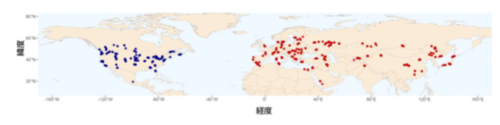
図1. 本研究で用いたヒメムカシヨモギ個体群のサンプリング地点。青色が原産地域のサンプリング地点、赤色が侵入地域のサンプリング地域を示している。
<関連情報>
- https://www.fpu.ac.jp/press-release/q156570.html
- https://www.fpu.ac.jp/press-release/q156570_d/fil/tsunoda.pdf
世界中に分布する雑草の集団ゲノム解析により、その地域適応と近年の個体群動態史に関する知見が得られる Population Genomics of a Cosmopolitan Weed Provides Insights Into Its Local Adaptation and Recent Demographic History
Marilia Souza Lucas, Christoph Rosche, Isabell Hensen, Stefan G. Michalski, Dávid U. Nagy, Diana Gamba, Renske E. Onstein, Karime Abidkulova, Mohammad Al-Gharaibeh, Ali A. Al-Namazi ,…
Molecular Ecology Published: 20 May 202
DOI:https://doi.org/10.1111/mec.70368
ABSTRACT
Invasive plant species present a growing ecological and economic challenge, and often adapt rapidly to their novel environments through complex demographic and evolutionary processes. Invasion genomics offers powerful tools to disentangle these processes, but most studies rely on geographically narrow sampling across native and non-native ranges. Erigeron canadensis is a cosmopolitan weed native to North America that has successfully invaded diverse climates worldwide. We used double-digest restriction site-associated DNA sequencing (ddRADseq) to investigate the genetic diversity and structure of 280 E. canadensis populations across the Northern Hemisphere. We found that native and non-native populations maintained comparable genetic diversity. Population structure analyses revealed four genetic clusters that were mainly differentiated along latitudinal and aridity gradients. However, one cluster was strongly overrepresented in the non-native compared to the native range. In the native range, genetic differentiation was shaped by spatial and environmental gradients, while in non-native regions human-mediated dispersal and repeated introductions disrupted environmentally driven genetic structure. Migration network analyses revealed limited intercontinental connectivity and a possible role of long-distance dispersal in within-range expansions. Genomic offset analyses showed that genotype-environment mismatches in non-native populations associated with reduced growth and reproduction. Together, our results indicate that the invasion dynamics of E. canadensis were driven by multiple introductions, population admixture, and lineage sorting, while some genotypes contributed disproportionately to the spread of this invader. The presence of apparent maladaptation suggests that even long-established invaders may still be evolving in response to their novel environment, raising concerns about potential future expansions.
![LDLコレステロールを厳格に下げても、リポプロテイン(a)[Lp(a)]高値は心血管イベントの「残余リスク」](https://oup.silverchair-cdn.com/oup/backfile/Content_public/Journal/eurheartj/PAP/10.1093_eurheartj_ehag446/2/m_ehag446_sga.jpeg?Expires=1786038951&Signature=3t2nWAU98mhbGJhcqtW7mooWdpaW6V6V35why1cjBK-DvrZEpF2vn~C975UHgBmKWFSOsQyZK3Hv8u8I-VzR4JRSp2Ad~g~1xd6fwXBiM6-Okzt74e4GcOlYxH4INuughcXv0Nnv-rBWtEBI9A-FG6HZsJMOhlFkXNkFLRkaOOHhJmNdq~-fOrY~zYKSD46QumWf1FYkgnE4xgkhxrRNMaNYyQepvHGWXYDoenQ-3igUsNxtT2TbElYI2NtBVhdWreyPy~Phc2-V5d7XYXMIXaBMhoOvFxiNePPFKRUkVaekogQ0MOLsbOMLHdlU-6tLCbHk~q-g7BDs2nuar4vH3A__&Key-Pair-Id=APKAIE5G5CRDK6RD3PGA "LDLコレステロールを厳格に下げても、リポプロテイン(a)[Lp(a)]高値は心血管イベントの「残余リスク」")