2026-05-12 兵庫県立大学
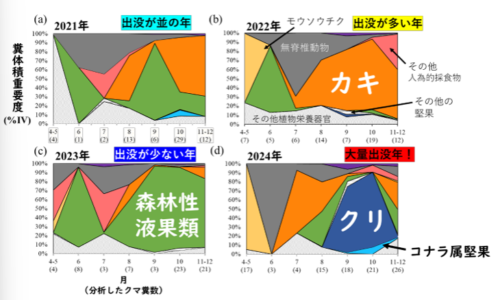
図1 2021年~2024年におけるツキノワグマ近畿北部西側個体群の糞内容物の変化
<関連情報>
- https://www.u-hyogo.ac.jp/news/pressrelease/20260512press.html
- https://www.u-hyogo.ac.jp/20260512-1press.pdf
- https://bioone.org/journals/mammal-study/volume-51/issue-3/ms2025-0045/Seasonal-and-Yearly-Variation-of-Food-Habit-for-Asiatic-Black/10.3106/ms2025-0045.full
西日本、温暖帯里山景観におけるツキノワグマ( Ursus thibetanus )の食性の季節的・年間変動 Seasonal and Yearly Variation of Food Habit for Asiatic Black Bears (Ursus thibetanus) in the Satoyama Landscape of the Warm Temperate Zone, Western Japan
Kazuteru Mikuni, Makoto Udo, Mayumi Yokoyama, Yoshiki Morimitsu, Daisuke Fujiki
Mammal Study Published:4 May 2026
DOI:https://doi.org/10.3106/ms2025-0045
Abstract
Understanding the food habits of Asiatic black bear (Ursus thibetanus) in the Satoyama landscape is crucial for developing effective management strategies. To understand that, in the warm temperate zone of Western Japan, we analyzed 288 fecal samples from the western part of Northern Kinki. The results indicated a strong dependence on anthropogenic foods such as Diospyros kaki from summer to autumn and Phyllostachys edulis in spring. Notably, hard mast of Quercus species, which are dominant in the study area, were less preferred than soft mast. Dietary composition fluctuated annually. From 2021 to 2023, the consumption of D. kaki fluctuated annually depending on the availability of soft mast in the forest. Consequently, bear captures in and around villages also fluctuated. Autumn 2024 was a poor mast year for many tree species, including soft mast and D. kaki, resulting in a mass bear occurrence. In this autumn, Castanea crenata (hard mast) served as the most consumed item. This suggests that soft mast functions as regular “main food item” for bears during autumn in the study area. Conversely, D. kaki serves as an “alternative food item” during years of poor soft mast availability, while C. crenata may serves as further “alternative food item”.