2026-06-03 マウントサイナイ医療システム(MSHS)
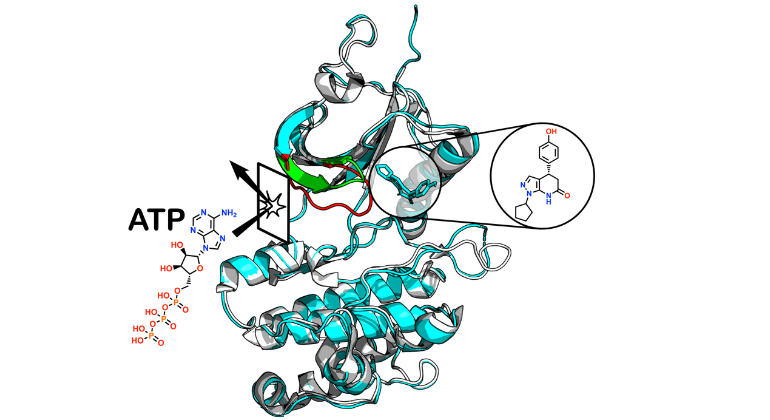
Researchers at the Icahn School of Medicine at Mount Sinai discovered a previously hidden pocket on PKMYT1, a protein involved in controlling how cells grow and divide, that current AI tools and experiments had missed. Their findings potentially open a new route to more selective drug design. Image credit: Herrington, et al., Journal of the American Chemical Society
<関連情報>
- https://www.mountsinai.org/about/newsroom/2026/scientists-uncover-hidden-drug-binding-pocket-in-cancer-protein-highlighting-the-power-and-limitations-of-ai-drug-discovery
- https://pubs.acs.org/doi/10.1021/jacs.6c05178
PKMYT1のアロステリック阻害は、特異的で不活性なATP結合部位構造を誘導する Allosteric Inhibition of PKMYT1 Induces a Unique, Inactive ATP Binding Site Conformation
Noah B. Herrington,Susmita Khamrui,Yihan Zhao,Carisse Lansiquot,Ruoxi Wu,Gaurav Pandey,Michael B. Lazarus,and Avner Schlessinger
Journal of the American Chemical Society Published: June 2, 2026
Doi:https://doi.org/10.1021/jacs.6c05178
Abstract
The protein kinase PKMYT1 regulates a key cell cycle checkpoint as part of the cell’s DNA-damage repair response, but in cancer, this function can promote tumor cell survival through avoiding mitotic catastrophe. PKMYT1 has been linked to a variety of cancer types, including breast, gastric, and nonsmall cell lung cancers, as well as kidney renal clear cell carcinoma, making it an important therapeutic target. However, potent and selective small-molecule inhibitors of PKMYT1 are scarce, and its specific biological role in tumor proliferation remains understudied. Here, we report the discovery and characterization of a novel PKMYT1 inhibitor, P29, bound to a previously unknown allosteric site. Structural and kinetic data reveal that P29 induces a conformational rearrangement of the P-loop and inhibits PKMYT1 through a mixed ATP competitive and noncompetitive mechanism. A closely related analogue, P32, exhibits selectivity and enhanced potency and engages PKMYT1 in cells. Surprisingly, however, it binds in the ATP binding pocket, demonstrating that subtle chemical modifications can shift binding mode and mechanism of inhibition. Furthermore, computational analysis using structural modeling methods, including AlphaFold2, AlphaFold3, Boltz-2, as well as unbiased MD simulations, indicates that these approaches are limited in their ability to capture this inhibitor-induced cryptic binding site and conformational change. Our study identifies an underexplored allosteric site in PKMYT1 and establishes a new avenue for the rational design of selective kinase inhibitors targeting a cryptic binding site in this emerging drug target. These findings also reveal intrinsic challenges in the computational discovery of noncanonical kinase binding sites and underscore the necessity of integrating computational modeling with experimental testing using structural and functional approaches.