2026-06-09 東京大学
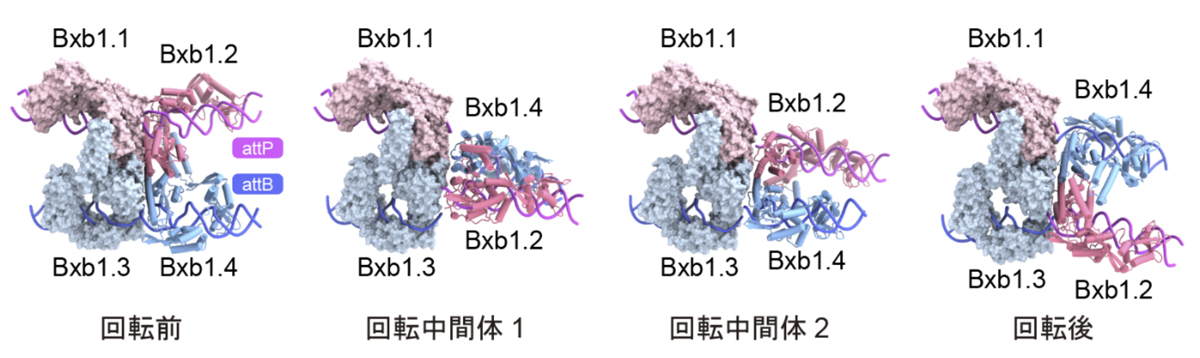
Bxb1–attP–attB複合体のクライオ電子顕微鏡構造
<関連情報>
- https://www.rcast.u-tokyo.ac.jp/ja/news/release/20260609.html
- https://www.sciencedirect.com/science/article/abs/pii/S1097276526003242
遺伝子導入のための大型セリンリコンビナーゼBxb1の構造とエンジニアリング Structure and engineering of the large serine recombinase Bxb1 for gene integration
Teppei Soma, Masahiro Hiraizumi, Christopher W. Fell, Dario Tagliaferri, Jason Lequyer, Sae Okazaki, Yukari Isayama, Kazuki Kato, Sworaj Sapkota, Harsh Ramani, Benjamin Arya, Cian Schmitt-Ulms, Keitaro Yamashita, Jonathan S. Gootenberg, Omar O. Abudayyeh, Hiroshi Nishimasu
Molecular Cell Available online: 8 June 2026
DOI:https://doi.org/10.1016/j.molcel.2026.05.018
Highlights
- Cryo-EM structures of the Bxb1-attP-attB synaptic complex in four distinct states
- Asymmetric assembly of attP- and attB-bound Bxb1 dimers into a synaptic complex
- Strand-exchange mechanism via subunit rotation through a hydrophobic flat interface
- Structure-guided engineering of Bxb1 variants with enhanced recombination activity
Summary
The large serine recombinase Bxb1 catalyzes recombination between DNA molecules containing compatible attP and attB sequences, offering broad applications in genome engineering and gene therapies. Here, we present cryo-electron microscopy structures of the Bxb1-attP-attB synaptic complex in four distinct functional states during its recombination cycle. Notably, the Bxb1 complex structures in the pre-, mid-, and post-strand-exchange states explain how the attP- and attB-bound Bxb1 dimers are assembled into a tetrameric synaptic complex and how an approximately 180° rotation occurs between the left and right dimers after DNA cleavage, thereby enabling DNA strand exchange and religation. Furthermore, we engineered Bxb1 variants with altered DNA preferences and enhanced recombination activity, which improved programmable gene integration in human cells. Overall, our findings advance the mechanistic understanding of large serine recombinases and provide a structural framework for future engineering of Bxb1-mediated genome integration technologies.