2026-06-18 東北大学
◆研究では、寿命延長効果が確認されたマウスの介入実験データと、げっ歯類、サル、ヒトを含む1万1000件以上の公開RNA-seqデータを統合解析し、老化や疾患、若返りに共通する分子変化を評価するモデルを構築した。解析の結果、炎症・免疫応答の活性化、ミトコンドリア機能低下、脂質代謝異常などが加齢と死亡リスクに共通する主要因であることが判明した。一方、若返りモデルではこれらの変化が逆方向に進むことも確認された。さらに、血液中のCDKN1A、GPNMB、LGALS3タンパク質が死亡リスクや疾患リスクと関連する有望なバイオマーカーであることが示された。従来のDNAメチル化に基づくエピジェネティック時計に比べ、tAgeは組織や細胞ごとの遺伝子活動を反映し、老化や寿命介入の効果をより直接的に評価できる特徴を持つ。本成果は、老化関連疾患の早期リスク評価や治療効果判定、健康寿命延伸研究、さらには若返り技術の評価基盤として活用されることが期待される。
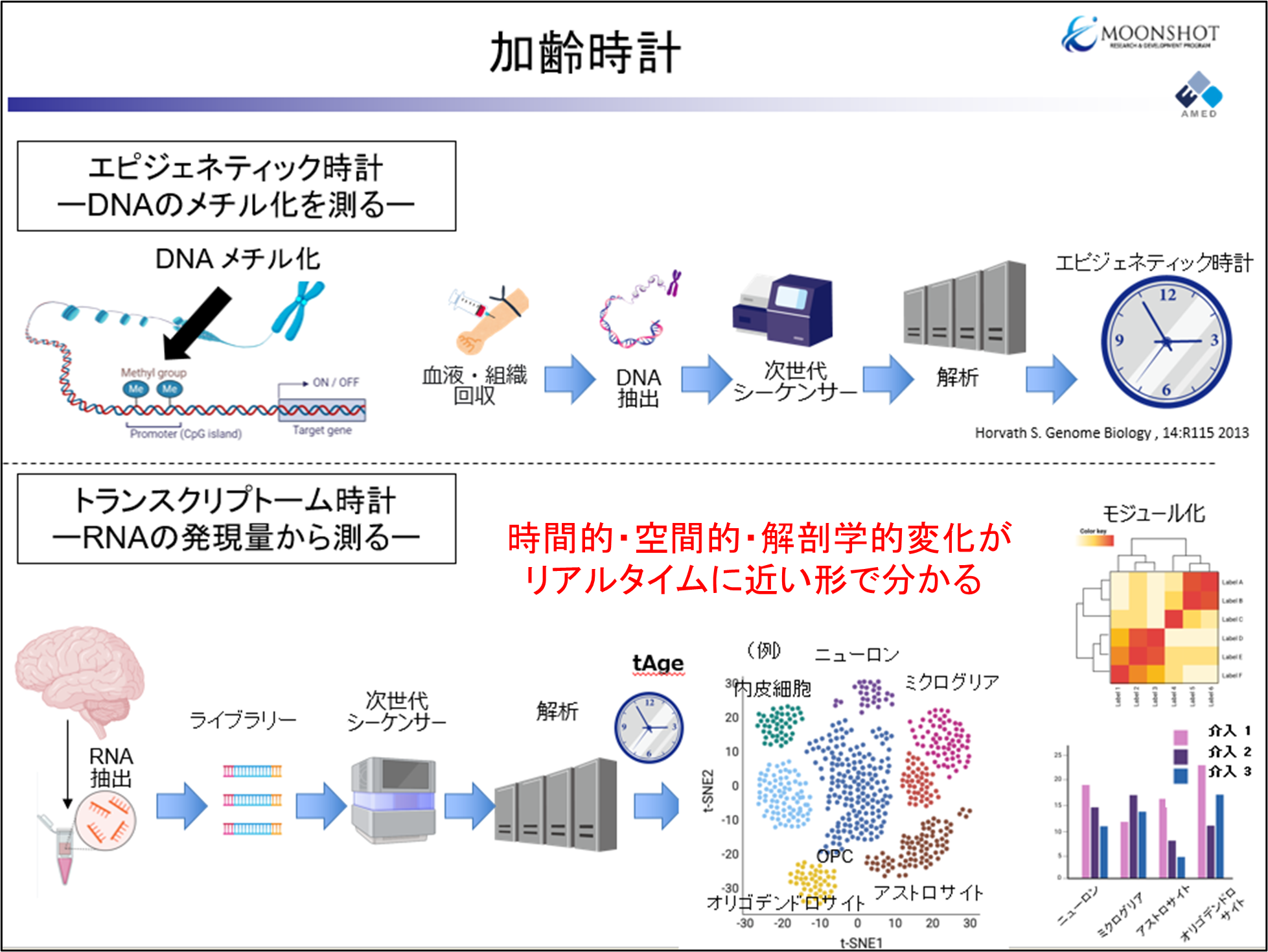
図1. 本研究成果の概念図
- https://www.tohoku.ac.jp/japanese/2026/06/press20260618-02-aging.html
- https://www.nature.com/articles/s41586-026-10542-3
哺乳類の老化と死亡率における普遍的な転写産物特徴 Universal transcriptomic hallmarks of mammalian ageing and mortality
Alexander Tyshkovskiy,Daria Kholdina,Maria Davitadze,Adrian Molière,Alibek Moldakozhayev,Yoshiyasu Tongu,Tomoko Kasahara,Dmitrii Glubokov,Alec Eames,Leonid M. Kats,Anastasiya Vladimirova,Kejun Ying,Hanna Liu,Bohan Zhang,Uma Khasanova,Mahdi Moqri,Jeremy M. Van Raamsdonk,David E. Harrison,Randy Strong,Takaaki Abe,Sergey E. Dmitriev & Vadim N. Gladyshev
Nature Published:27 May 2026
DOI:https://doi.org/10.1038/s41586-026-10542-3
Abstract
Ageing and interventions modulate health and mortality1, yet the underlying molecular mechanisms of this modulation remain unclear. Here we integrate more than 11,000 transcriptomes from more than 25 tissues across 4 mammals (mouse, rat, macaque and human) to develop accurate, interpretable rodent and multi-species biomarkers of chronological age and expected mortality, predicting lifespan-modulating interventions, time to death, chronic diseases and rejuvenation. Ageing-related changes were conserved across species and cell types, revealing universal transcriptomic signatures of mammalian ageing and mortality, including CDKN1A and LGALS3, whose protein levels were also associated with mortality and multimorbidity in UK Biobank. Mortality-associated features were recapitulated across in vivo and in vitro damage-accumulation models, including inflammation, replicative senescence, metabolic inhibition and γ-irradiation, and were attenuated or reversed by cell immortalization, reprogramming, heterochronic parabiosis and early embryogenesis. Network analysis uncovered a modular architecture of ageing- and mortality-associated hallmarks, encompassing inflammation, interferon signalling, mitochondrial function, chromatin modification and extracellular matrix organization. To quantify ageing of individual cellular components, we developed module-specific clocks, which revealed pathway-specific effects of interventions: chronic diseases primarily accelerated inflammatory-module ageing, whereas caloric restriction and Klotho (also known as Kl) deficiency targeted mitochondrial and metabolic modules. Transcriptomic and DNA methylation clocks showed correlated age acceleration in human blood, which was strongest for the chromatin-associated module clock, highlighting mechanistic links between molecular ageing modalities. This study reveals conserved signatures and a modular architecture of mortality regulation, providing a framework for quantifying and targeting ageing of cellular subsystems across species and tissues.