2026-06-24 京都大学
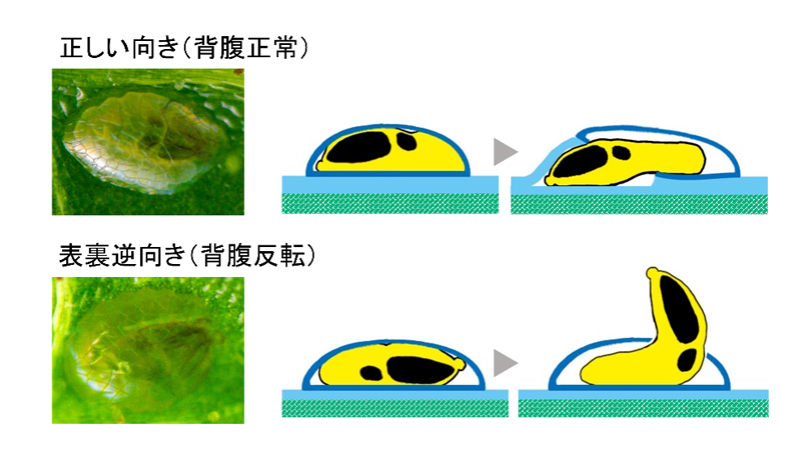
クルミホソガの孵化と葉内への侵入プロセスの模式図。正常な向きの卵からは幼虫が直接葉の中に穿孔する(上図)が、背腹が反転した卵では頭部が外側に飛び出してしまい、侵入できずに死亡する(下図)。図の作成者:近藤陽香
<関連情報>
- https://www.kyoto-u.ac.jp/ja/research-news/2026-06-24
- https://www.kyoto-u.ac.jp/sites/default/files/2026-06/web-2606-Ono-d0b42d3a71723f9dd2676987ed52faa8.pdf
- https://royalsocietypublishing.org/rsbl/article/22/6/20260164/482198/An-unrecognized-fine-scale-host-plant-adaptation
潜葉性昆虫における今まで知られていなかった微細スケールでの寄主植物適応:正確な卵の背腹軸の向きが葉内への侵入成功に不可欠である An unrecognized fine-scale host-plant adaptation in a leaf miner: correct dorsoventral egg orientation is essential for successful leaf entry
Haruka Kondo;Issei Ohshima;Hajime Ono
Biology Letters Published:24 Jun 2026
DOI:https://doi.org/10.1098/rsbl.2026.0164
Abstract
Larvae of leaf miners live within leaves and feed on internal tissues, making successful entry into the leaf essential for their endophagous lifestyle. In the leaf-mining moth Acrocercops transecta, females lay eggs on the surface of host-plant leaves. Immediately after hatching, larvae penetrate the leaf directly through the eggshell, representing the only opportunity to enter host leaves. Under laboratory conditions, we observed substantial mortality caused by failure of leaf entry. The nearly transparent eggshell of A. transecta enabled observation of embryonic development, revealing that correct dorsoventral orientation, ventral side facing the leaf epidermis, is essential for successful mining, whereas inverted orientation leads to failure. We developed a novel egg transplantation method and showed that correcting inverted embryos by flip transplantation restored mining success, while inverting normally oriented embryos prevented it. Notably, inverted embryos were also observed under natural conditions, causing mortality in first-instar larvae. Furthermore, under laboratory conditions, the mortality rates differed between the horticultural host Juglans regia and the natural host J. mandshurica. These results reveal a previously unrecognized source of mortality in leaf miners and demonstrate that precise dorsoventral orientation during oviposition is essential for offspring survival, highlighting a fine-scale egg-loading mechanism shaping successful host adaptation in insects.