
2026-06-24 エディンバラ大学
<関連情報>
- https://www.ed.ac.uk/news/protein-linked-to-severe-covid-and-lung-disease
- https://www.nature.com/articles/s41467-026-74280-w
疾患関連の遺伝子変異は、組織特異的なタンパク質アイソフォームにミスセンス効果を引き起こす可能性がある Disease-associated genetic variants can cause missense effects in tissue-specific protein isoforms
Giovanna Weykopf,Mihaly Badonyi,Elias T. Friman,Jasmine Minh Hang Nguyen,Alexis Ioannou,Benjamin J. Livesey,Audrey Coutts,Elizabeth F. Hird,Murray Wham,Chloe M. Stanton,Veronique Vitart,Jing Su,Lee Murphy,J. Kenneth Baillie,Mark D. Gorrell,Joseph A. Marsh,Wendy A. Bickmore & Simon C. Biddie
Nature Communications Published:16 June 2026
DOI:https://doi.org/10.1038/s41467-026-74280-w Unedited version
Abstract
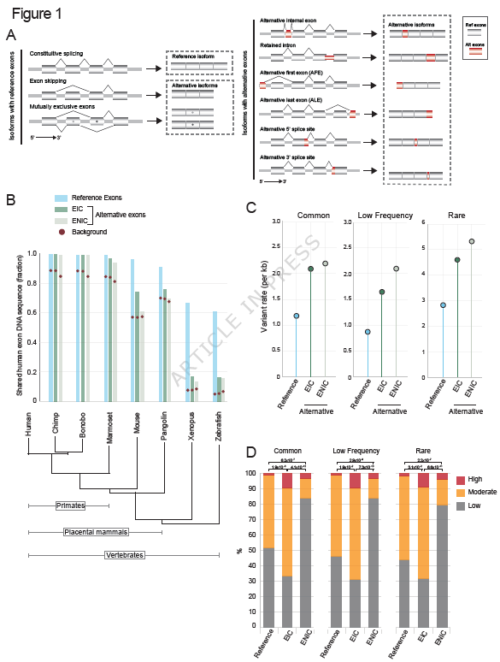
Genetic variants can cause protein-coding mutations that result in disease. Variants are typically interpreted using the reference transcript for a gene. However, most human multi-exon genes have alternative isoforms. We show that, consistent with their reduced evolutionary constraint, coding exons in alternative isoforms harbour more population variants than exons of reference isoforms, and that these variants are more likely to cause nonsynonymous mutations. Common and rare disease-associated variants mapping to alternative transcripts can lead to amino acid substitutions predicted to be structurally damaging in the corresponding protein isoform. The alternative transcripts to which disease-associated variants map demonstrate high tissue-specificity, with many unannotated in reference human genomes, and only revealed by long-read RNA-sequencing. As an example, we report an unannotated, alternative transcript of the inflammasome regulator DPP9 that is lung epithelium-specific, that harbours a common genetic variant associated with severe COVID-19 and lung fibrosis. Using deep RNA sequencing of full-length transcript isoforms by targeted capture, we confirm the expression of the unannotated DPP9 isoform. The DPP9 isoform variant causes a p.Leu8Pro missense mutation in an alternative first exon, predicted to disrupt the encoded alpha helix, and we show that the variant alters DPP9 enzymatic activity. Our findings highlight the importance of considering alternative isoforms, their tissue-specific expression, and full-length transcripts in variant interpretation, with implications for uncovering underappreciated mechanisms of both common and rare disease.
