2026-06-25 国立遺伝学研究所
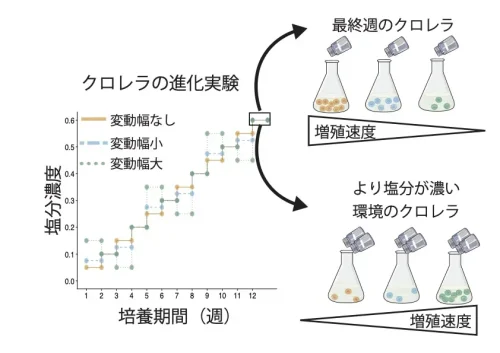
画像クレジット:フラスコのイラストは TOGO Picture Gallery(https://doi.org/10.7875/togopic.2011.9)、塩のイラストは Servier Medical Art(https://smart.servier.com/smart_image/salt-shaker/)を使用。いずれもCreative Commons Attribution 4.0 International License(CC BY 4.0)に基づき利用。
<関連情報>
環境変動が進化救済に及ぼす両刃の刃のような影響 The double-edged effect of environmental fluctuations on evolutionary rescue
Shota Shibasaki,Masato Yamamichi
Evolution Published:06 March 2026
DOI:https://doi.org/10.1093/evolut/qpag034
Abstract
Recent studies revealed that contemporary evolution can prevent population extinction in deteriorating environments. Such evolutionary rescue has been intensively studied, but few have focused on environmental fluctuations. As global changes alter both the mean and variance of environmental variables, it is crucial to understand how environmental fluctuations affect evolutionary rescue. Here, through the evolution experiments on green algae Chlorella vulgaris, we show that increasing the amplitude of environmental fluctuations around long-term deteriorating trends has negative and positive effects on evolutionary rescue. We first increased the salinity level gradually to 0.6M NaCl and found that the algae exposed to large fluctuations tended to grow more slowly. This seems to be because large fluctuations produce an episode of a huge environmental change, which can increase adaptation lag. Then, we increased the salinity level to 1M NaCl and found that the algae exposed to large fluctuations grew, while those exposed to smaller or no fluctuations did not. This seems enigmatic, but our mathematical model suggests that trait variance within a population might increase under large fluctuations, which can promote adaptive evolution. Our results highlight the complex role of environmental fluctuations in evolutionary rescue, calling for more investigations to understand evolutionary rescue in nature.