2026-07-06 マウントサイナイ医療システム((MSHS)
<関連情報>
- https://www.mountsinai.org/about/newsroom/2026/mount-sinai-researchers-discover-treatable-cause-of-severe-anemia-associated-with-a-cancer-therapy
- https://ashpublications.org/bloodrci/article/2/2/100052/565971/PARP-inhibitor-associated-folate-deficiency-anemia
PARP阻害剤関連葉酸欠乏性貧血 PARP inhibitor–associated folate deficiency anemia
N. Rippel,D. I. Nathan,W. Fu,J. M. Liu,I. Shapira,P. Klein
Blood Red Cells & Iron Published: March 26, 2026
DOI:https://doi.org/10.1016/j.brci.2026.100052
TO THE EDITOR:
BRCA proteins are central to the homologous recombination repair (HRR) pathways of double-stranded DNA breaks.1-3 Cancer cells harboring BRCA1/2 mutations are deficient in HRR, leading to their reliance on poly(ADP-ribose) polymerase (PARP) proteins’ base excision repair capabilities for tumorigenesis.4 The inhibition of PARP proteins has emerged as an effective therapeutic strategy for BRCA1/2-mutated malignancies by selectively inducing the persistence of DNA damage in BRCA deficient cells and inducing cellular death.5-7
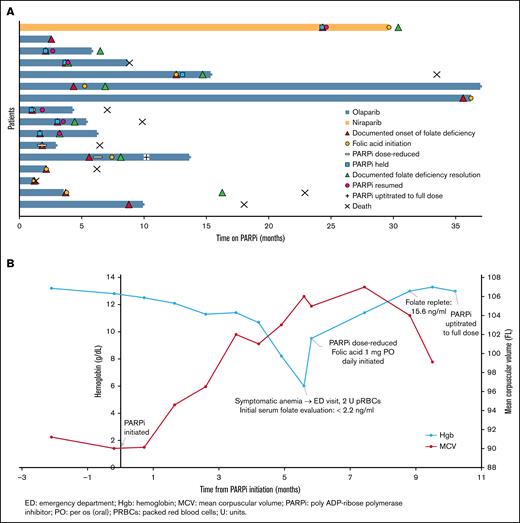
In recent years, 4 PARP inhibitors (PARPi), including olaparib, talazoparib, rucaparib, and niraparib, have gained US Food and Drug Administration (FDA) approval for the management of BRCA1/2-associated malignancies.8,9 Although PARPi demonstrate impressive antineoplastic efficacy, anemia has emerged as a common hematologic treatment-related adverse event.10-12 Several case reports and series have specifically described severe folate deficiency in PARPi-treated patients, often culminating in transfusion dependence within weeks of PARPi initiation.13-16 More recently, a prospective study of 9 olaparib-treated patients identified new-onset folate deficiency after olaparib initiation, although without clinically meaningful reductions in hemoglobin.17
Several hypotheses have been proposed to explain the mechanism of folate deficiency anemia with PARPi, including decreased intestinal folic acid (FA) absorption or increased consumption.14,18-22 The clinical impact of treatment-related folate deficiency anemia can be highly detrimental, with the potential to lead to significant fatigue, disruptions or discontinuation of cancer therapies, and avoidable medical interventions. However, this phenomenon has not been comprehensively investigated.
Here, we present, to our knowledge, the first large retrospective analysis aimed at characterizing folate deficiency in patients receiving PARPi. In addition, this study, to our knowledge, is the first to evaluate this phenomenon in a cohort that includes both male and female patients. We reviewed the records of 512 adult patients with BRCA1/2-mutated malignancies who were treated with PARPi within the Mount Sinai Health System between 1 January 2018 and10 October 2023. Institutional review board approval was obtained. Deidentified clinical data were acquired from the Mount Sinai Data Warehouse and by manual chart review. Categorical variables were summarized with frequencies and percentages, and continuous variables were presented as medians with interquartile ranges (IQR). Statistical significance was assessed using the Mann-Whitney U test for continuous variables and the Fisher exact test for categorical variables. Summary statistics were generated using R version 4.3.3.