
2026-07-07 合肥物質科学研究院(HFIPS)
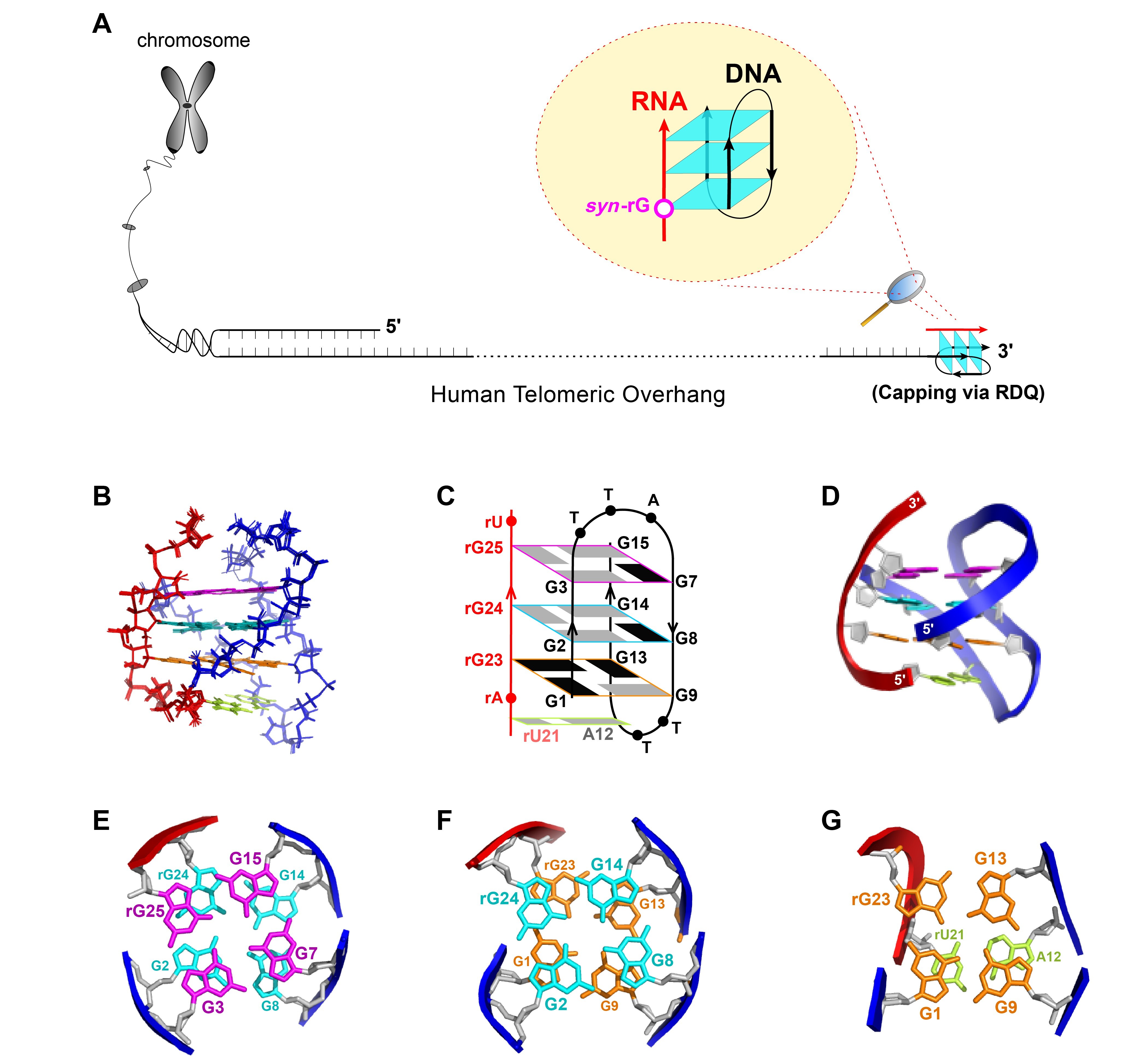
Schematic illustration showing the assembly of the RDQ and its capping/protective function at telomeric overhangs. (Image by FU Wenqiang)
<関連情報>
- https://english.hf.cas.cn/nr/rn/202607/t20260707_1176560.html
- https://pubs.acs.org/doi/10.1021/jacs.6c03261
NMRによる研究で明らかになった、(3 + 1)混合鎖配向を持つヒトテロメアDNA-TERRA RNAハイブリッドG四重鎖における、非典型的にSynグリコシド配座に適応するグアニンリボヌクレオチド A Guanine Ribonucleotide Atypically Adaptive to the Syn Glycosidic Conformation in a Human Telomeric DNA–TERRA RNA Hybrid G-Quadruplex with (3 + 1) Mixed Strand Orientations Studied by NMR
Wenqiang Fu,Wenxuan Hu,Haitao Jing,Tao Wang,Cece Wang,Fengnan Liu,Di Gao,Huiying Yuan,Ruixiang Pang,and Na Zhang
Journal of the American Chemical Society Published: June 25, 2026
DOI:https://doi.org/10.1021/jacs.6c03261
Abstract
The generation of RNA–DNA hybrid G-quadruplexes (RDQs) through heteromeric association between individual DNA and RNA G-rich strands has been proposed as an important mechanism in the regulation of genome transcription, replication, and telomere capping. Based on low-global-structure-resolution circular dichroism spectra, numerous RDQs have been routinely detected almost exclusively in a parallel topology because of the inherent preference of riboguanosine (rG) to adopt an anti glycosidic torsion angle. However, high atomic-resolution structures of RDQs resolved using nuclear magnetic resonance (NMR) spectroscopy, X-ray crystallography, or cryogenic electron microscopy (CryoEM) remain unavailable in the PDB database at present. To the best of our knowledge, this study is the first to present an NMR structure of a human telomeric RDQ (Htel-RDQ) assembled between a three-repeat human telomeric DNA strand of d(GGGTTAGGGTTAGGG) and a single-repeat TERRA RNA strand of r(UAGGGU). Interestingly, this Htel-RDQ uncommonly adopts a (3 + 1) hybrid topology featuring three parallel and one antiparallel strand orientations, with one rG atypically in the syn glycosidic torsion angle and a C2′-endo sugar pucker conformation. The findings of this study confirm that the inherent anti rG preference in RNA G-quadruplexes can be adaptively unrestricted in an RDQ assembly and disclose a latent structural complexity previously unanticipated in RDQs.

