2026-07-08 京都大学
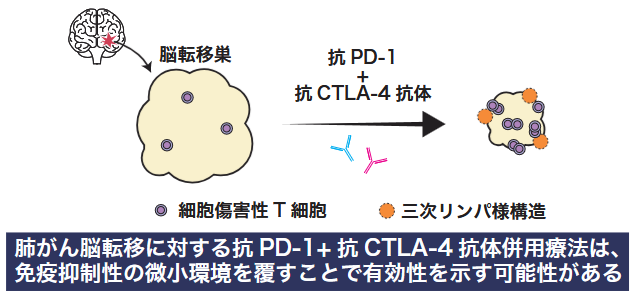
研究内容の概念図。非小細胞肺がん脳転移巣は細胞障害性T細胞浸潤・三次リンパ様構造形成が乏しい免疫抑制性の微小環境を有しているが、抗PD-1抗体と抗CTLA-4抗体の併用により免疫抑制性の微小環境を覆すことで有効性を示す可能性がある。作成:細谷和貴
<関連情報>
- https://www.kyoto-u.ac.jp/ja/research-news/2026-07-08
- https://www.kyoto-u.ac.jp/sites/default/files/2026-07/web-2607-Hosoya-1e3e7508cda68458dd1853d7570d5e87.pdf
- https://www.nature.com/articles/s41467-026-74782-7
抗PD-1抗体と抗CTLA-4抗体の併用療法は、CD8 + T細胞応答を増強し、三次リンパ組織の形成を促進することにより、非小細胞肺癌脳転移における免疫排除を克服する Anti-PD-1 plus anti-CTLA-4 blockade overcomes immune exclusion in NSCLC brain metastases by enhancing CD8+ T cell responses and promoting tertiary lymphoid structure formation
Kazutaka Hosoya,Hiroaki Ozasa,Takahiro Tsuji,Masahiro Oi,Yusuke Shima,Keiichiro Suminaga,Kentaro Hashimoto,Hiroshi Yoshida,Tomoko Funazo,Hitomi Ajimizu,Takashi Nomizo,Hironori Yoshida,Hiroyuki Katsuragawa,Kentaro Tsuji,Noritaka Sano,Shigeki Takada,Yohei Mineharu,Shigeto Nishikawa,Toshi Menju,Akihiko Yoshizawa,Yoshiki Arakawa,Hiroaki Wake & Toyohiro Hirai
Nature Communications Published:07 July 2026
DOI:https://doi.org/10.1038/s41467-026-74782-7
Abstract
Brain metastases (BrMs) in non-small cell lung cancer (NSCLC) respond poorly to anti-PD-1 monotherapy, but the underlying immune resistance remains incompletely defined. Here we integrate clinical outcome analyses, paired human tissue profiling and syngeneic mouse models to characterize the BrM immune microenvironment. Clinical analyses suggest improved intracranial disease control with nivolumab plus ipilimumab compared with nivolumab alone. Paired human specimens show that BrMs contain fewer cytotoxic T lymphocytes (CTLs) and tertiary lymphoid structures (TLSs) than primary tumors, defining an immune-excluded phenotype. A syngeneic BrM model recapitulates this phenotype and resists anti-PD-1 monotherapy, whereas combined anti-PD-1 and anti-CTLA-4 blockade suppresses tumor growth and prolongs survival. Single-cell RNA sequencing, flow cytometry and immunofluorescence show increased CTL infiltration and effector function after combination therapy. CD8+ T cell depletion abrogates therapeutic benefit, and combination therapy expands T follicular helper-like cells and induces TLS-like structures. These findings manifest increased adaptive immune response of dual checkpoint blockade in NSCLC BrMs.