2026-07-01 スタンフォード大学
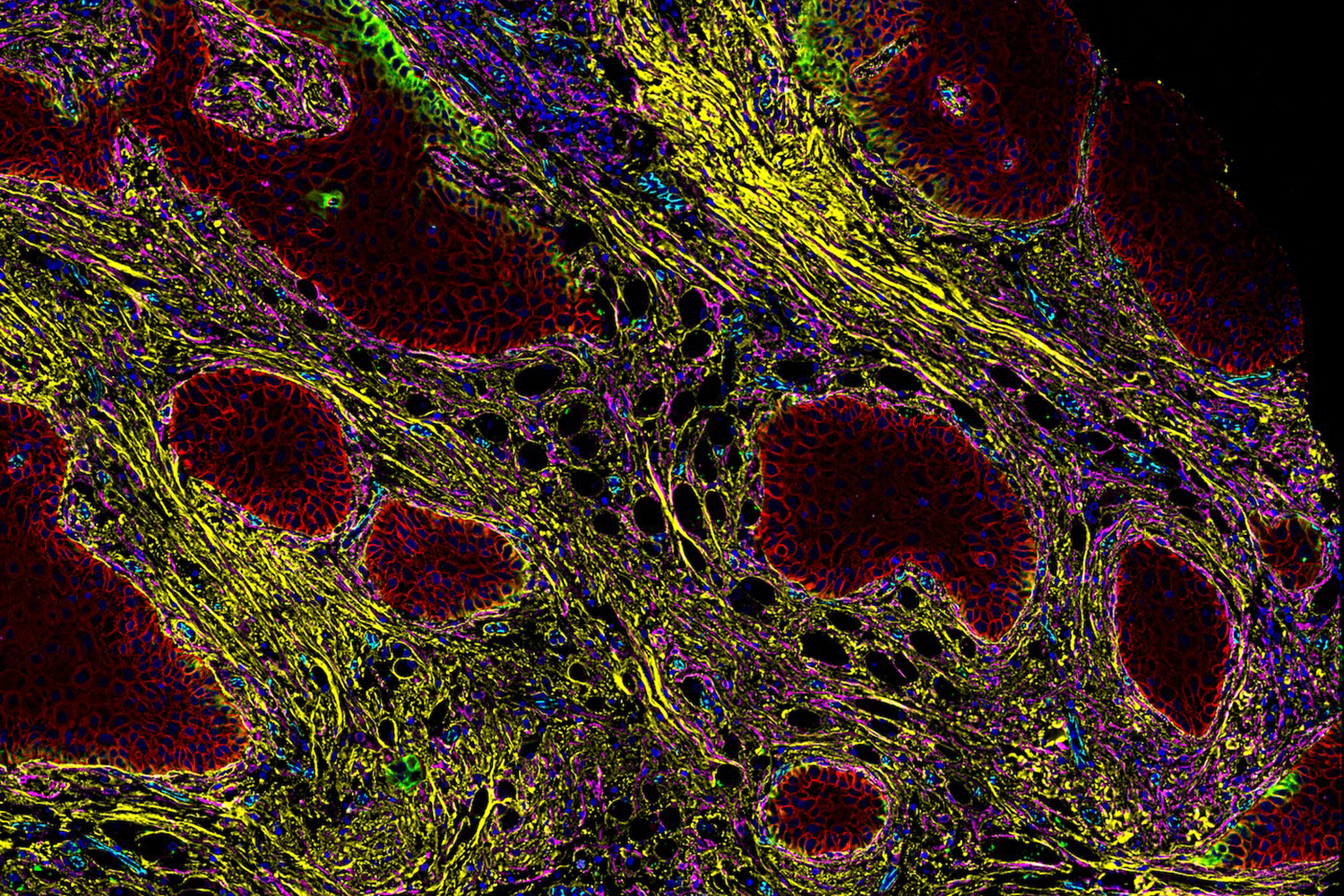
Nests of tumor cells (red) in a head and neck cancer are difficult for therapeutic antibodies (green) to penetrate in areas where the extracellular matrix (yellow) of the stroma is dense. | Guolan Lu
<関連情報>
- https://news.stanford.edu/stories/2026/07/cancer-fighting-antibodies-imaging-technique
- https://www.nature.com/articles/s41587-026-03152-x
単一細胞空間薬理学により、ヒト固形腫瘍における治療用抗体送達に対する保存された間質バリアが特定された Single-cell spatial pharmacobiology identifies conserved stromal barriers to therapeutic antibody delivery in human solid tumors
Guolan Lu,John W. Hickey,Maximilian Haist,Xulei Qin,Emily Zhao,Abdullah Naveed,Erna Forgo,Marc-A. Baertsch,Lucas Mani,Xavier Rovira-Clavé,Andrey Finegersh,Yury Goltsev,Chiara Caraccio,Nynke S. van den Berg,Marisa Hom,Deana R. Colburg,Brock A. Martin,Christina S. Kong,Natalie S. Lui,George A. Fisher,A. Dimitrios Colevas,Robert B. West,Greg M. Thurber,George A. Poultsides,… Eben L. Rosenthal
Nature Biotechnology Published:03 June 2026
DOI:https://doi.org/10.1038/s41587-026-03152-x
Abstract
The development of effective antibody therapeutics has been hampered by a lack of methods to measure drug delivery and activity within tumors at single-cell resolution. Here we introduce single-cell spatial pharmacobiology (SSP), an experimental and analytical framework that integrates in situ imaging of a systemically infused, fluorescently labeled therapeutic antibody with high-plex spatial proteomics to quantify antibody distribution, target engagement and tumor microenvironment (TME) architecture. We applied SSP to tumor tissues from participants with head and neck squamous cell carcinoma and pancreatic ductal adenocarcinoma who received the antibody panitumumab-IRDye800 in phase 1 trials. SSP identified pronounced spatial heterogeneity in single-cell drug delivery and target engagement, shaped by conserved stromal barriers, including periostin-rich extracellular matrix assemblies and fibroblast-activation-protein-positive cancer-associated fibroblast neighborhoods, which were associated with reduced antibody delivery in both tumor types. SSP measures drug–target–TME interactions in human tumors and can support studies of resistance mechanisms, dosing strategies and discovery of spatial biomarkers for precision oncology.