2026-07-14 兵庫県立大学
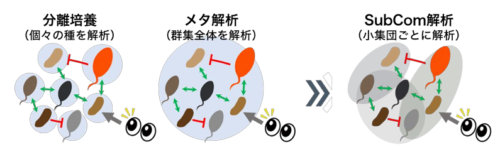
図1 従来法と比較したSubCom解析の特徴
<関連情報>
- https://www.u-hyogo.ac.jp/news/pressrelease/20260714press.html
- https://www.u-hyogo.ac.jp/20260714press.pdf
- https://link.springer.com/article/10.1186/s40168-026-02460-3
SubCom解析:微生物群集の機能を分類群ごとの寄与と相互作用の状況に分解する SubCom analysis: dissecting microbial community functions into taxon-specific contributions and interaction contexts
Hidehiro Ishizawa,Miku Kito,Sunao Noguchi,Kodai Kimura & Masahiro Takeo
Microbiome Published:09 July 2026
DOI:https://doi.org/10.1186/s40168-026-02460-3 Unedited version
Abstract
Background
Microbial communities play fundamental roles in industrial processes and ecosystem stability. However, understanding how individual members and their interactions give rise to community-level function remains challenging because such functions emerge from complex interactions among diverse members.
Results
In this study, we developed SubCom analysis, a subcommunity-based experimental–computational workflow for inferring candidate taxon-specific contributions and interaction contexts underlying microbial community function. Using an aniline-degrading microbial community, we generated paired composition–function data from 558 randomly assembled, low-complexity subcommunities constructed using a dilution-and-dispense strategy. We then trained decision-tree-based models to predict community function from composition, achieving high predictive performance (r = 0.77–0.89). Interpretation of the learned decision rules identified taxa with consistent functional association: specific Pseudomonas and Acinetobacter taxa were associated with increased community-level aniline utilization, whereas an Achromobacter taxon exhibited a negative association despite its presumed role in downstream metabolism. The models further suggested potential functional interactions, including attenuation of the positive contributions of Pseudomonas and Acinetobacter in the presence of a Corynebacterium taxon, highlighting functional relationships that are not readily inferred from genome-based approaches alone. An augmentation assay using representative isolates supported the predicted direction of several effects and enabled targeted improvement of community function.
Conclusions
These results demonstrate the potential of SubCom analysis as a practical framework for inferring taxon-specific contributions and interaction contexts in complex, nonsynthetic microbial communities.