2026-08-05 東京科学大学
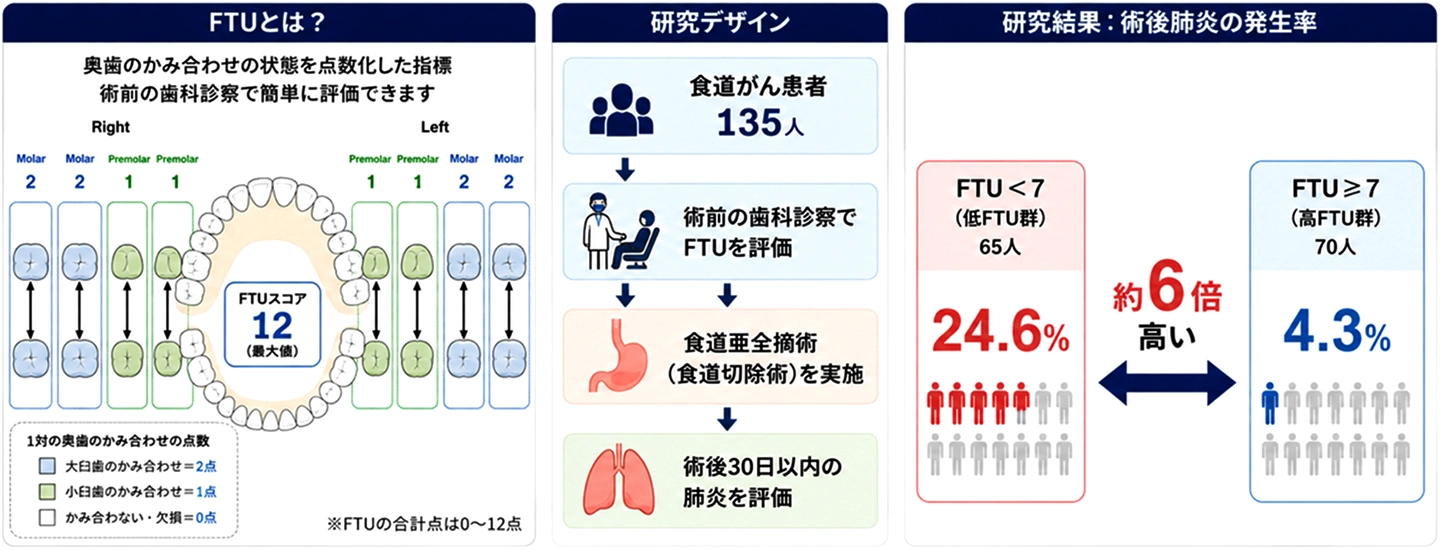
図1. 本研究成果の概要
<関連情報>
- https://www.isct.ac.jp/ja/news/d16zvq1w55rw
- https://www.ejso.com/article/S0748-7983(26)00640-2/abstract
食道癌に対する亜全摘術後の肺合併症予測における機能歯単位の臨床的意義 Clinical significance of functional tooth units in predicting pulmonary complications after subtotal esophagectomy for esophageal cancer
Kei Ishihara ∙ Keisuke Okuno ∙ Risako Mikami ∙ … ∙ Masanori Tokunaga ∙ Koichiro Matsuo ∙ Yusuke Kinugasa
European Journal of Surgical Oncology Published:July 17, 2026
DOI:https://doi.org/10.1016/j.ejso.2026.112021
Abstract
Background
Postoperative pulmonary complications (PPCs) remain a major cause of morbidity after esophagectomy despite advances in perioperative management, including routine perioperative oral care. Functional tooth units (FTU), a measure of occlusal support, reflect oral functional status related to mastication and swallowing. We investigated the association between preoperative FTU and PPCs after subtotal esophagectomy.
Methods
We retrospectively analyzed 135 patients who underwent subtotal esophagectomy for esophageal cancer at the Institute of Science Tokyo Hospital, between 2022 and 2025. FTU score was assessed preoperatively via dental examination, and patients were classified into the low-FTU (<7, n = 65) and high-FTU (≥7, n = 70) groups. The incidence of PPCs within 30 postoperative days was compared between the groups.
Results
The median age was significantly higher in the low-FTU group than in the high-FTU group (73 vs. 64 years, P < 0.001). PPCs occurred in 19 of 135 patients (14.1%), and the incidence was significantly higher in the low-FTU group than in the high-FTU group (24.6% vs. 4.3%, P = 0.001). The postoperative hospital stay was longer in the low-FTU group (16 vs. 14 days, P = 0.009). Low FTU was significantly associated with PPCs in multivariable logistic regression analysis (odds ratio, 6.54; 95% confidence interval, 1.76–24.38; P = 0.005).
Conclusions
FTU was significantly associated with PPCs after esophagectomy for esophageal cancer, suggesting its potential as a simple and clinically useful predictor of oral function for perioperative risk stratification of pulmonary complications.