
2026-08-05 マサチューセッツ工科大学(MIT)
<関連情報>
- https://news.mit.edu/2026/scientists-unveil-600-new-tissue-models-human-cancer-0805
- https://www.nature.com/articles/s41586-026-10806-y
- https://www.nature.com/articles/s41586-026-10830-y?fromPaywallRec=false
多様な癌に対する次世代患者由来モデルの概要 A compendium of next-generation patient-derived models for diverse cancers
Dina ElHarouni,Mushriq Al-Jazrawe,Seongmin Choi,Merve Dede,Toshinori Hinoue,Sean A. Misek,Heeju Noh,Luca Zanella,Yuen-Yi Tseng,Hayley E. Francies,Dennis Plenker,Cindy W. Kyi,Julyann Perez-Mayoral,Megan J. Stine,Eva Tonsing-Carter,Rachana Agarwal,Jean Claude Zenklusen,James M. Clinton,Jennifer M. Shelton,Timothy R. Chu,William F. Hooper,Xavi Loinaz,Paula Keskula,Jordan Tagle,The HCMI Network,… Jesse S. Boehm
Nature Published:05 August 2026
DOI:https://doi.org/10.1038/s41586-026-10806-y
Abstract
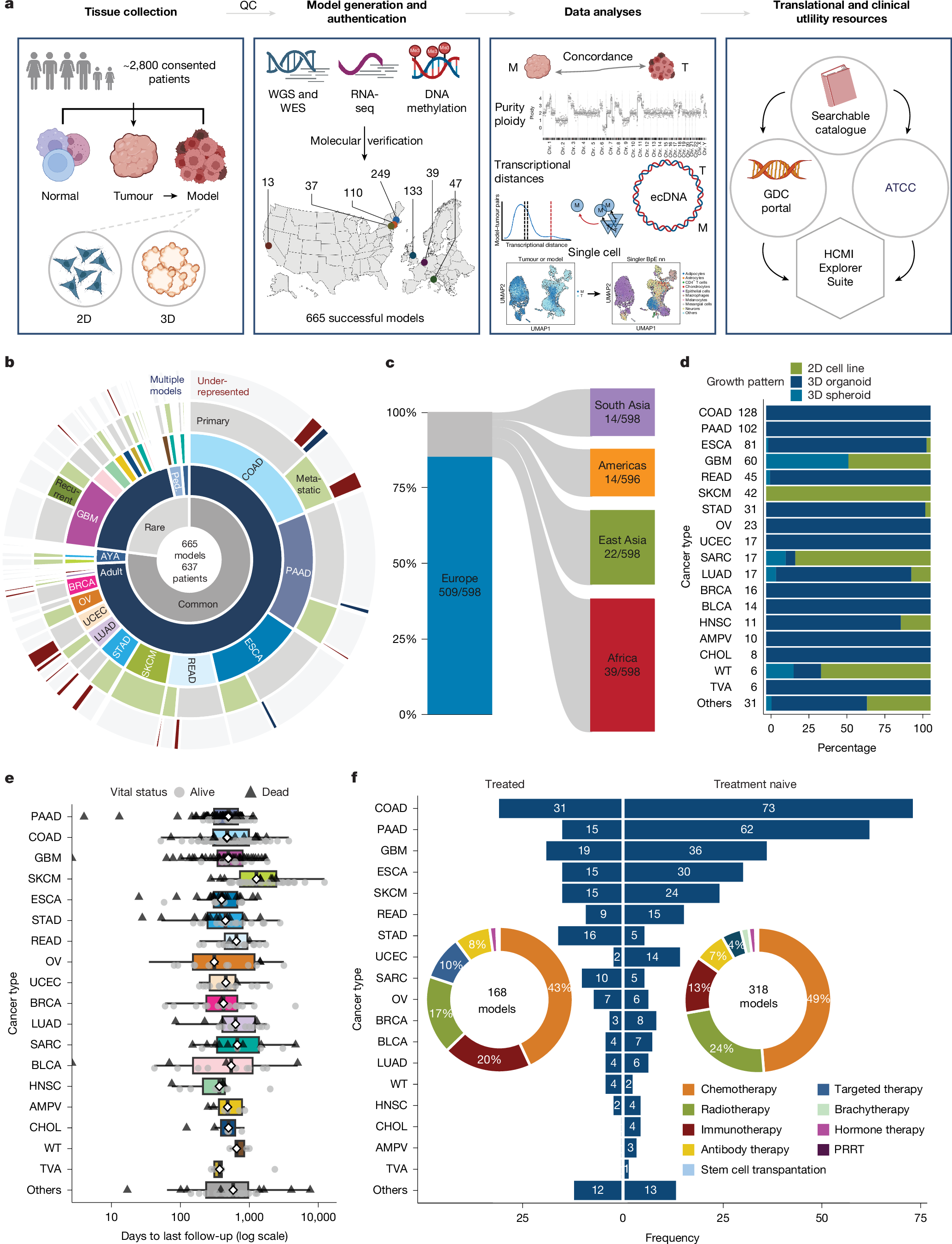
The development of new therapeutics and the validation of pathogenetic cancer mechanisms require representative laboratory models1,2. However, existing collections represent only a fraction of the diversity observed in human cancer2,3,4. Recent technologies have enabled efficient in vitro model derivation (for example, tumour organoids)5. However, whether these maintain essential properties of patient tumours during long-term expansion has not been systematically investigated. Here we present results of a large-scale international programme—the Human Cancer Models Initiative—which involved the generation of a resource of 665 next-generation models from 2,780 donors with 25 cancer types and integrated tumour–model whole genome, exome, methylome and transcriptome analyses. The resource provides 522 models with comprehensive clinical data, 153 models of rare cancers and 71 models from participants with non-European ancestry. Analyses of 421 matched tumour–model pairs reveal high genetic (97.8%) and epigenetic (95%) concordance and define correlates of model discordance. Single-nucleus RNA sequencing of tumour–model pairs reveals subsets of models in which culture conditions significantly influence cell states. Finally, we characterize model preservation of extrachromosomal DNA and post-treatment mutational signatures to provide opportunities to study therapeutic resistance. This model repository is being made available to the community—including multimodal molecular profiling, clinical information and integrative software tools—thus providing a valuable resource for preclinical investigation of cancer pathogenesis and treatment response.
腫瘍由来オルガノイドバイオバンクが癌遺伝子の依存性をマッピングする A tumour-derived organoid biobank maps cancer gene dependencies
C. Herranz-Ors,S. G. Bhosle,A. E. Beck,J. G. R. Gilbert,G. Picco,J. Espejo Valle-Inclan,F. Muyas,S. Valentini,A. E. Andres,R. Ansari,S. Barthorpe,G. Battarbee,C. M. Beaver,S. Brocklesby,J. Cantwell,C. A. Collins,J. Davis,H. G. Dimitrova,J. Doran,E. Efendi,K. Evans,M. Fekry,T. A. Fowler,M. Garcia-Casado,OCCAMS Consortium,… M. J. Garnett
Nature Published:05 August 2026
DOI:https://doi.org/10.1038/s41586-026-10830-y
Abstract
Cancer cell lines remain foundational for research and drug discovery, yet they incompletely capture tumour diversity, lack linked patient context, and have undergone adaptation to culture. Tumour organoids are three-dimensional cultures derived from patient tissue that offer a powerful complement to cell lines1. Here we derived and characterized 256 clinically annotated tumour organoids directly from colorectal, oesophageal, ovarian, pancreatic and gastric cancers as renewable, genetically stable models. Extensive characterization of each model and matched patient tumour samples included whole-genome and transcriptome sequencing, and genome-wide CRISPR–Cas9 screens across 162 organoids mapped gene dependencies. Integrative analyses revealed genomic and clinical markers of dependency across common and rare subtypes, identified organoid-specific essential genes, and revealed targetable vulnerabilities following tumour evolution in paired pre- and post-treatment samples. In colorectal cancer, functional and pharmacological interrogation of the EGFR–RAS–MAPK axis uncovered differential effects of KRAS variant alleles. This open, publicly available resource provides a systematic map of gene dependencies in patient-derived organoids, expanding the model diversity and mechanistic insight needed to advance precision oncology.

