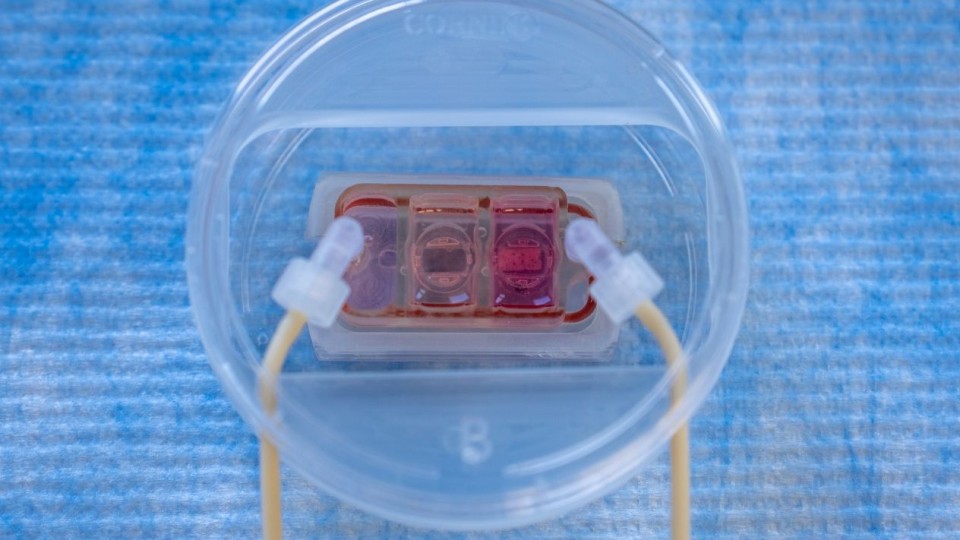
2026-08-17 マサチューセッツ工科大学(MIT)
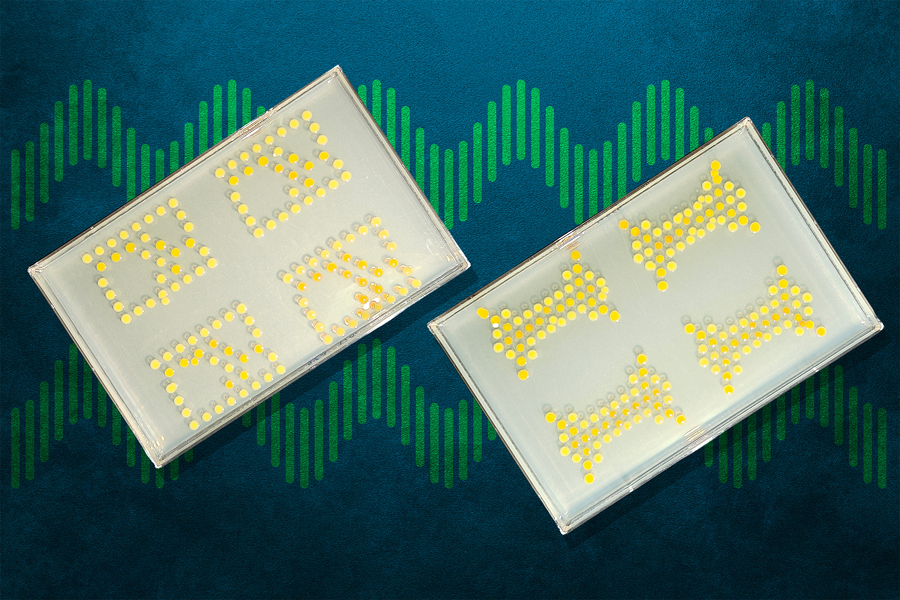
MIT researchers have engineered bacteria that can function as transistors, allowing them to create “living circuit boards” like those shown. Credit: Courtesy of the researchers, edited by MIT News
<関連情報>
- https://news.mit.edu/2026/mit-engineers-connect-bacteria-to-create-living-transistors-0817
- https://www.nature.com/articles/s41589-026-02300-3
細菌トランジスタを印刷して作られた生体回路基板 Living circuit boards built by printing bacterial transistors
Hamid Doosthosseini,Haorong Chen & Christopher A. Voigt
Nature Chemical Biology Published:17 August 2026
DOI:https://doi.org/10.1038/s41589-026-02300-3
Abstract
The multicellular forms and functions seen in biology are controlled by cellular communication and collective computation. Reprogramming natural systems is difficult because they comprise many signaling molecules connecting a web of regulatory networks within cells. Here we apply principles from pass transistor logic (PTL) to design bacteria that can be easily reconfigured to perform computations on a solid surface. Strains of Pantoea agglomerans were built to encode two transistors (N-type and P-type) whose inputs and outputs are small molecules. They are connected by three relay strains that convert molecular diffusion to unidirectional flow. To build circuits, an acoustic liquid handler prints patterns of these five strains on a surface. By changing the pattern, not requiring any genetic changes, different operations are implemented, including multi-input multioutput logic, demultiplexor, half-adder and full-adder. This work demonstrates that only five cell types, each encoding a simple operation, can be scaled to create complex computational operations.