
2026-08-21 東京大学
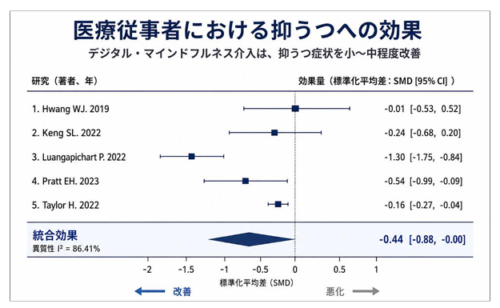
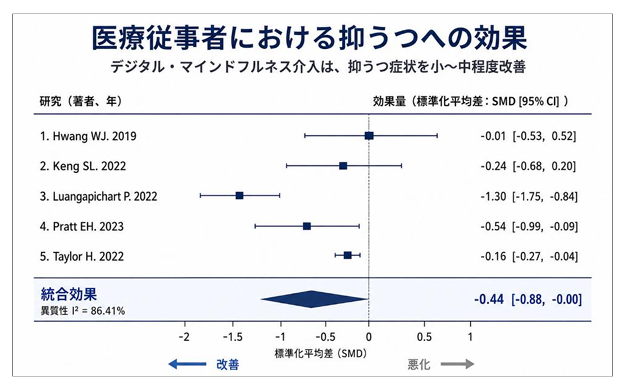
図1:医療従事者における抑うつへの効果
<関連情報>
自己主導型デジタルマインドフルネス介入が医療従事者のメンタルヘルスに及ぼす影響:ランダム化比較試験の系統的レビューとメタ分析 Effects of Self-Guided Digital Mindfulness Interventions on the Mental Health of Health Care Workers: Systematic Review and Meta-Analysis of Randomized Controlled Trials
Natsu Sasaki; Akiomi Inoue; Mako Iida; Kazuhiro Watanabe; Yuka Kobayashi; Asuka Sakuraya; Hisashi Eguchi; Kanami Tsuno; Yu Komase; Yasumasa Otsuka; Mai Iwanaga; Reiko Inoue; Kazuto Kuribayashi; Ayako Hino; Hiroki Asaoka; Satoru Kanamori; Yuta Inagawa; Takenori Yamauchi; Hiroki Ikeda; Go Muto; Rika Kato; Takuro Okuyama; Naomichi Tani; Noriko Kojimahara; Takeshi Ebara; Akihito Shimazu; Akizumi Tsutsumi; Norito Kawakami; Kotaro Imamura
JMIR mHealth and uHealth Published:21.Aug.2026
DOI:https://doi.org/10.2196/74272
Abstract
Background:Mindfulness interventions are considered an effective strategy for preventing mental health problems among health care workers (HCWs). While prior reviews have often included facilitator-guided or multicomponent interventions, it is unclear whether self-guided digital mindfulness interventions can also be effective without professional or in-person support.
Objective:This systematic review aimed to investigate the effects of self-guided digital mindfulness interventions on the mental health and well-being of HCWs.
Methods:This work was conducted as part of the DeLiGHT project. We searched electronic databases, including PubMed (MEDLINE), Embase, Cochrane CENTRAL, PsycINFO, PsycARTICLES, and the Japan Medical Abstract Society database, from inception in 2010 to July 25, 2023. To ensure timeliness, we performed an updated search on December 27, 2025. Database searching yielded 37,851 abstracts and 145 studies that examined the effectiveness of digital health interventions for workers in the initial 2023 screen. In the present study, we limited the included studies to those that met the following criteria: randomized controlled trials (RCTs) using self-guided digital mindfulness interventions (eg, smartphone apps or web-based programs) delivered without face-to-face or professional support compared to waiting list controls or usual care among HCWs. The updated search in 2025 yielded 6328 additional records, of which 11 studies were examined. Study quality was assessed using the Cochrane Risk of Bias tool, with meta-analyses conducted using a random-effects model.
Results:A total of 9 RCTs with 3088 participants were included in the final analysis. The study populations were diverse, covering North America, Europe, Oceania, and Asia. Interventions were delivered via various digital platforms, including commercial mindfulness apps (n=3), social networking service tools (n=3), and web-based programs (n=3), with an average duration of 6.17 weeks (range: 1.5‐18 wk). Five studies assessed outcomes only postintervention, and 4 included short-term follow-up (4‐12 wk); no long-term effects were evaluated. The meta-analysis showed a significant beneficial effect on depression (standardized mean difference [SMD]=−0.44, 95% CI −0.88 to −0.00; P=.049), anxiety (SMD=−0.29, 95% CI −0.51 to −0.06; P=.011), perceived stress (SMD=−0.42, 95% CI −0.77 to −0.06; P=.02), and well-being (SMD=0.20, 95% CI 0.09 to 0.30; P<.001) immediately postintervention. The adherence rates reported across studies were highly variable, ranging from 19% to 56%. According to the Cochrane Risk of Bias tool, most studies were rated as having some concerns or a high risk of bias. The certainty of evidence included in the analysis ranged from “Low” to “Very Low.”
Conclusions:Overall, low to very low certainty evidence suggests that self-guided digital mindfulness interventions may have short-term beneficial effects on depression, anxiety, perceived stress, and well-being among HCWs. Future high-quality studies are needed to examine the long-term effects and cross-cultural generalizability of these interventions.
