2026-08-24 鹿児島大学
<関連情報>
- https://www.kagoshima-u.ac.jp/topics/2026/08/post-2475.html
- https://www.jneurosci.org/content/early/2026/07/28/JNEUROSCI.0358-26.2026
異質な内側前頭前皮質の神経細胞群は、選択行動中に再現可能な内部時間ダイナミクスを示す Heterogeneous medial prefrontal cortex ensembles exhibit reproducible internal temporal dynamics during choice behavior
Takeru Suzuki, Daisuke Joho, Hiroyuki Okuno and Masaki Kakeyama
Journal of Neuroscience Published:30 July 2026
DOI:https://doi.org/10.1523/JNEUROSCI.0358-26.2026
Abstract
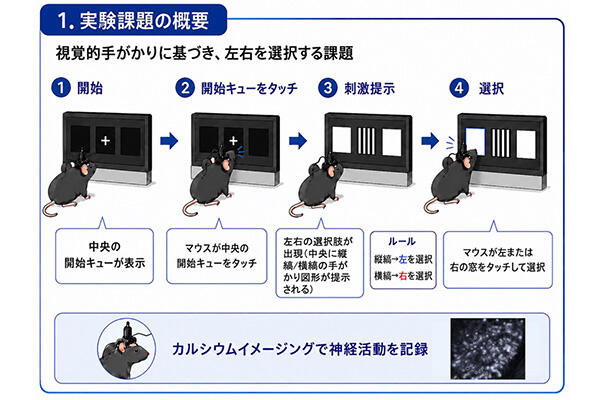
Decision-making requires the coordinated integration of sensory information, internal states, and learned rules across time. While the medial prefrontal cortex (mPFC) is known to contribute to this process, how population-level neural activity in the mPFC is temporally organized during decision-making remains unclear. Here, we investigated neuronal population activity in the mPFC of male mice using in vivo calcium imaging while animals performed a touchscreen-based visual cue-dependent location-choice task. We found that mPFC population activity exhibited a stable, low-dimensional, and continuous temporal structure that emerged reproducibly across trials. Using circular phase decoding, we found that these internal population dynamics tracked trial progression across pre-stimulus, stimulus, and post-stimulus epochs. At the single-neuron level, a large proportion of mPFC neurons exhibited reliable, time-locked activity changes around task events. Hierarchical clustering summarized these heterogeneous responses into temporally organized response profiles spanning different phases of the task. Choice-related decoding was observed across these mPFC response profiles, whereas decoding performance in the primary somatosensory cortex (SSp) remained near chance. Together, these results suggest that mPFC population activity exhibits reproducible temporal organization during visual cue-dependent choice behavior, linking single-neuron heterogeneity with population-level progression dynamics.