2026-08-28 東北大学
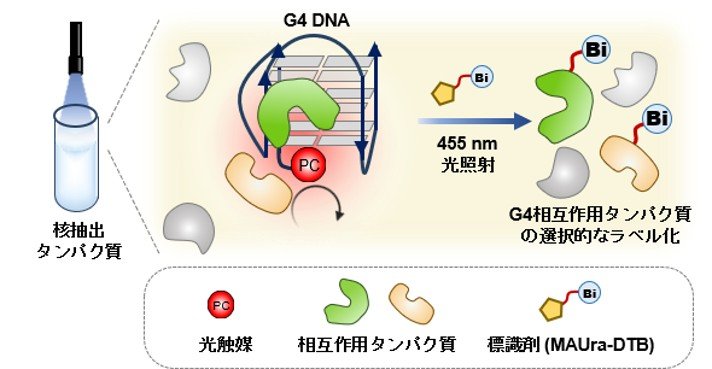
図1. 本研究で開発した光触媒近接標識法の概念図
<関連情報>
- https://www.tohoku.ac.jp/japanese/2026/08/press20260828-01-protein.html
- https://www.nature.com/articles/s42004-026-02170-9
G四重鎖DNA相互作用タンパク質の同定のための光触媒近接標識法 Photocatalytic proximity labeling for the identification of G-quadruplex DNA-interacting proteins
Ahmed Mostafa Abdelhady,Shinichi Sato,Tatsuki Masuzawa,Keishi Deguchi,Mizuki Oba,Takemaru Sato,Nodoka Mase,Toshifumi Yamanaka,Jamila Abbas Osman,Maho Kato,Keita Nakane,Zhengyi Liu,Kazuki Kuwahara,Satoru Nagatoishi,Kouhei Tsumoto,Fumi Nagatsugi,Takanori Oyoshi & Kazumitsu Onizuka
Communications Chemistry Published:27 August 2026
DOI:https://doi.org/10.1038/s42004-026-02170-9
Abstract
DNA–protein interactions play an essential role in fundamental cellular biological processes. Herein, we report a photocatalytic proximity labeling approach for the broad screening of G-quadruplex (G4)-interacting proteins (G4IPs) using human telomere G4 DNA modified with a photocatalyst (Ruthenium complex or BODIPY). We confirmed efficient labeling of unwinding protein 1 (UP1), a model of G4-interacting protein, with 1-methyl-4-arylurazole (MAUra) as a labeling reagent under blue light irradiation. We applied this labeling approach to nuclear extract proteins and identified labeled proteins using quantitative proteomics analysis. Numerous unknown G4 binding protein candidates were identified. Notably, the hexokinase-1 (HK1) protein was identified as a G4IP, and its selective binding toward G4 DNA was confirmed. This finding could be used to highlight the essential subcellular G4-mediated functions of HK1. The proposed labeling approach is a promising tool for investigating the protein interactions of the higher-order structural motifs and functional nucleic acids.