2026-09-09 京都大学
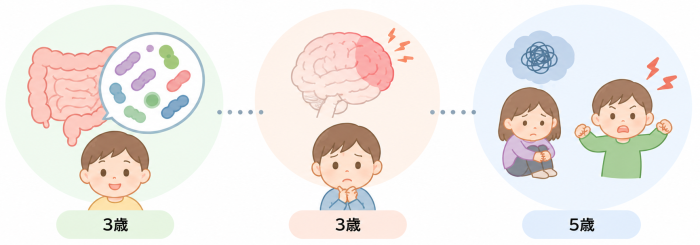
幼児期の腸内細菌叢は、この時期の感情制御を介してその後の問題行動と関連する(作成者:明和政子 生成AI(ChatGPT GPT-5.6 Sol)を活用して作成)
<関連情報>
- https://www.kyoto-u.ac.jp/ja/research-news/2026-09-09-1
- https://www.sciencedirect.com/science/article/pii/S266691532600137X
ヒトの幼児期における気質と腸内細菌叢の関係 Emotion Regulation Difficulties as a Developmental Pathway Linking Early-Life Gut Microbiota Composition to Subsequent Problematic Behaviors: A Longitudinal Study
Masako Myowa, Hideaki Fujihara, Kairi Baba, Satoshi Watanabe, Aya K. Takeda, Michiko Matsunaga
Journal of Affective Disorders Reports Available online: 6 September 2026
DOI:https://doi.org/10.1016/j.jadr.2026.101159
Highlights
- Longitudinal study links gut microbiota at age 3 to behavior risk at age 5.
- Higher Coprobacillus abundance at age 3 was linked to later behavior risk.
- Lower Granulicatella abundance at age 5 was linked to internalizing risk.
- Gut microbiota composition may be an early marker of mental health risk.
Abstract
Problematic behaviors during childhood are associated with an increased risk of later mental health difficulties. Emerging evidence suggests that the gut microbiota may contribute to behavioral problems by influencing the development of executive function (EF), particularly explicit emotion regulation (EER). This longitudinal study investigated whether gut microbiota composition was associated with the risk of problematic behaviors. We analyzed data from 68 typically developing children assessed at both 3 and 5 years of age. Gut microbiota composition and EF, including EER, were assessed at ages 3 and 5 using 16S rRNA gene sequencing and the Behavior Rating Inventory of Executive Function–Preschool Version, respectively. The risk of problematic behaviors was assessed at age 5 using the Child Behavior Checklist. A higher relative abundance of Coprobacillus at age 3 was associated with poorer EER at age 3, which was prospectively associated with an increased risk of both externalizing (indirect effect = 0.29, 95% CI [0.01, 1.04]) and internalizing behavioral problems (indirect effect = 0.28, 95% CI [0.01, 0.87]) at age 5. In addition, a lower relative abundance of Granulicatella at age 5 was associated with poorer EER at age 5, which mediated the association with internalizing behavioral problems at age 5 (indirect effects = −0.35 and −0.36; 95% CIs [−1.32, −0.07] and [−1.18, −0.05], respectively). These findings provide evidence that gut microbiota composition may represent an early indicator of subsequent mental health risk. However, given the sample size and the number of taxa examined, these findings should be regarded as exploratory.