2026-09-11 名古屋大学
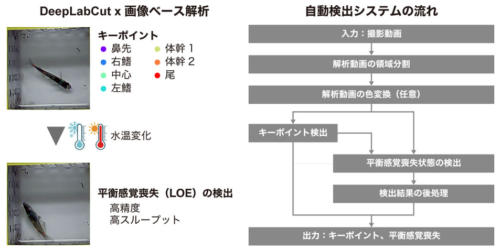
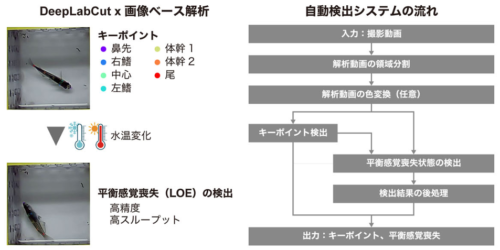
図 1 DeepLabCut と AI 画像解析を組み合わせた自動 LOE 検出システム左:DeepLabCut により、メダカの体の各部位(鼻先・右鰭・左鰭・中心・体幹 1・体幹 2・尾)をキーポイントとして自動追跡する。
<関連情報>
- https://www.nagoya-u.ac.jp/researchinfo/result/2026/09/ai-112.html
- https://www.nature.com/articles/s41598-026-66712-w
DeepLabCutを用いた自動評価システムによるメダカ系統およびメダカ近縁種の多様な温度耐性の解明 DeepLabCut-based automated system reveals diverse temperature tolerance among medaka strains and related Oryzias species
Yoshiya Matsuo,Takuya Kato,Kiyoshi Naruse,Takashi Yoshimura,Tatsuhito Hasegawa & Tomoya Nakayama
Scientific Reports Published:10 September 2026
DOI:https://doi.org/10.1038/s41598-026-66712-w
Abstract
Temperature is a critical environmental factor influencing the physiology and behavior of ectothermic animals, yet conventional methods for evaluating thermal tolerance in fish rely on subjective manual observation of loss of equilibrium (LOE), limiting experimental throughput and introducing observer bias. Here, we developed an automated temperature tolerance evaluation system integrating DeepLabCut-based pose estimation with custom image processing algorithms to objectively quantify the timing of LOE during thermal stress tests. Our system incorporated region partitioning and color transformation preprocessing to improve keypoint detection accuracy, followed by a classification model combining ResNet34-based frame features with keypoint coordinates to objectively determine the timing of LOE without manual observation. Validation against manual annotation showed that the automated system achieved an accuracy comparable to the natural variability between trained investigators, and outperformed naive human observers, supporting its validity as an objective and reproducible alternative to manual scoring. Using this system, we characterized cold and heat tolerance across six medaka strains (Oryzias latipes: d-rR/TOKYO, HB11A, OK-Cab, HO5 and HdrR-II1; O. sakaizumii: HNI-II). Cold and heat tolerance assessment revealed inter-strain variation, with HdrR-II1 among the most cold- and heat-tolerant strains and HNI-II the least tolerant of both cold and heat stress. We further evaluated cold tolerance in medaka-related species (O. sinensis, O. cabaranensis, O. curvinotus, O. luzonensis, O. celebensis, and O. javanicus) and zebrafish (Danio rerio), revealing substantial interspecific variation that broadly corresponded with latitudinal distribution. O. latipes, distributed at the highest latitudes among the tested species, exhibited the greatest cold tolerance, whereas O. celebensis, O. javanicus, and other tropical or low-latitude species showed comparatively low cold tolerance. Our automated system provides a robust, high-throughput platform for thermal tolerance evaluation and, combined with the genetic and genomic resources available in medaka, establishes a foundation for elucidating the molecular mechanisms underlying temperature adaptation in fish.