2026-09-18 国立長寿医療研究センター
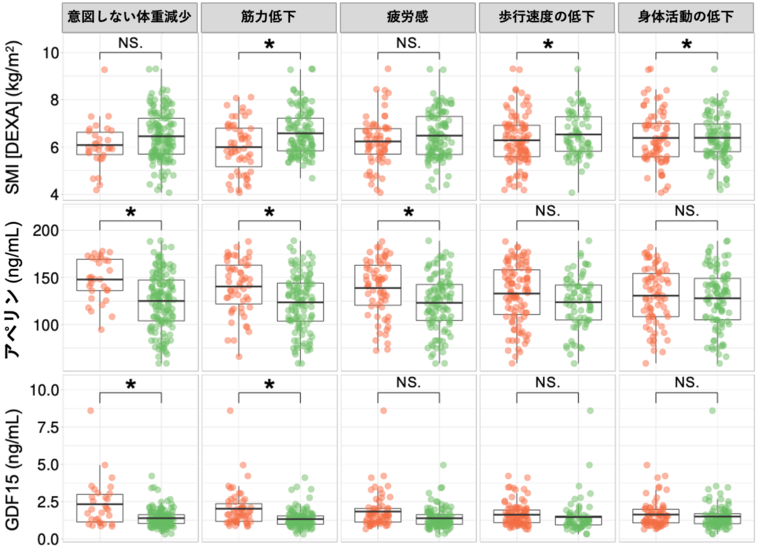
図1. SMI、アペリン、GDF15とJ-CHS診断基準項目との関連
<関連情報>
高齢者の虚弱評価および筋力低下予測のためのバイオマーカーパネルの検証と改良 Validation and refinement of a biomarker panel for frailty assessment and prediction of muscle weakness in older adults
Akiko Yamakawa, Tohru Hosoyama, Marie Takemura, Shumpei Niida, Kouichi Ozaki, Shosuke Satake & Daichi Shigemizu
npj Aging Published:17 September 2026
DOI:https://doi.org/10.1038/s41514-026-00488-1
Abstract
Frailty is a complex geriatric syndrome characterized by age-related declines in physiological function and cognitive reserve. To promote early prevention and intervention, minimally invasive and objective biomarkers that can detect frailty progression are required. We aimed to identify biomarkers associated with frailty progression and to elucidate their relevance to the Japanese version of the Cardiovascular Health Study (J-CHS) criteria, consist of five components (unintentional weight loss, self-reported exhaustion, muscle weakness, slow walking speed, and low physical activity). A total of 168 individuals (61 robust, 25 pre-frail, and 82 frail) enrolled in the NCGG (National Center for Geriatrics and Gerontology) Biobank were analyzed. Clinical information, blood-test data, aging-related factors, and gene-expression data were integrated for the analysis. First, linear regression identified one clinical factor, five aging-related factors, and 251 gene-expression factors associated with frailty. Subsequent logistic regression analyses examining each J-CHS components highlighted six candidate biomarkers. Cross-validation further suggested that three of these biomarkers—SMI, apelin, and GDF15—may represent potential biomarkers. Finally, retrospective and prospective analyses further demonstrated that those biomarkers were predictive of future muscle weakness, yielding a concordance index of 0.70. In conclusion, we validated and refined a biomarker panel consisting of SMI, apelin, and GDF15 that is associated with frailty, particularly muscle weakness (a major J-CHS component). These biomarkers may be useful for frailty assessment. Longitudinal analyses further suggested that they may be associated with the future development of muscle weakness in initially robust older adults, although validation in larger prospective cohorts is warranted.