2026-09-23 ワシントン大学セントルイス校
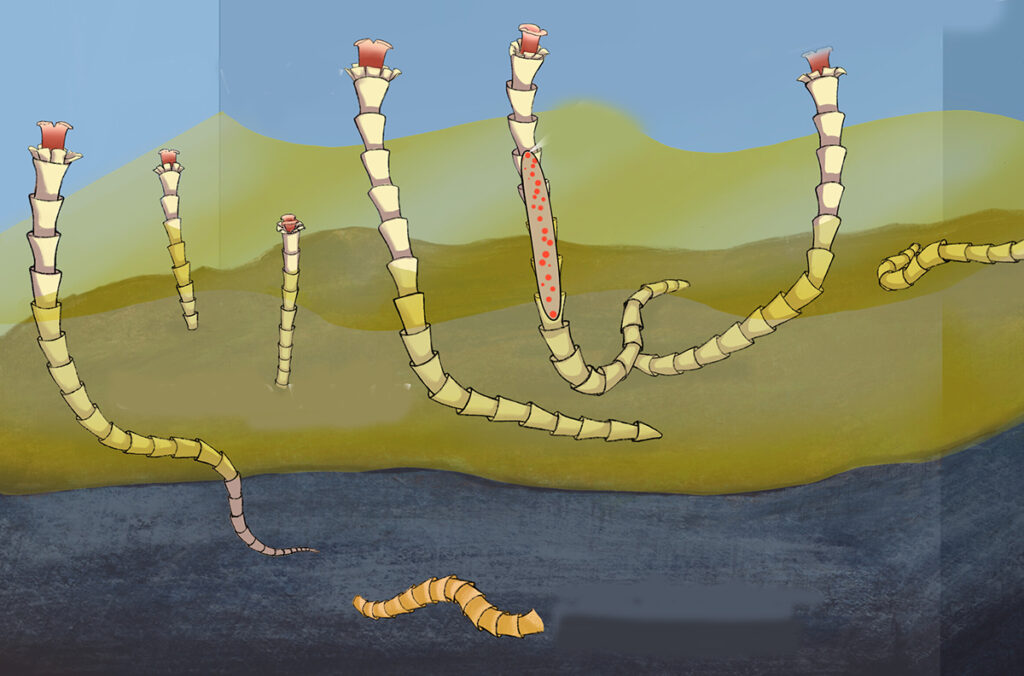
A reconstruction of Conotubus hemiannulatus and its symbiotic relationship with sulfur-oxidizing bacteria. (Image: David Fike)
<関連情報>
- https://source.washu.edu/2026/09/get-by-with-a-little-help-from-old-friends/
- https://www.pnas.org/doi/10.1073/pnas.2526201123
エディアカラ紀の管状動物における化学共生栄養戦略 Chemosymbiotic trophic strategy in an Ediacaran tubular animal
Zhenfei Wang, Yongbo Peng, Qing Tang, +8 , and Lisa M. Pratt
Proceedings of the National Academy of Sciences Published:August 24, 2026
DOI:https://doi.org/10.1073/pnas.2526201123
Abstract
Chemosymbiosis may have been a key driver of early animal evolution and diversification. Yet evidence for animal–microbe nutritional partnerships in the fossil record of early metazoans remains scarce, largely owing to the limited availability of robust geochemical proxies and suitable fossilization pathways. Here, we report extremely low molybdenum isotope (δ98Mo) values in pyritized fossils of the terminal Ediacaran Conotubus, a nonbiomineralized cloudinomorph representing some of the earliest metazoans. Such low δ98Mo values are otherwise only known in modern cold-seep chemosymbiotic tubeworms hosting sulfur-oxidizing bacterial symbionts. Homogeneously low δ34S signatures of fossils indicate that rapid pyritization in early diagenesis under euxinic taphonomic settings preserved primary Conotubus chitinous δ98Mo. Substantial δ34S fractionation relative to seawater sulfate and high Δ33S values indicate that active microbial H2S oxidation occurred within their habitat. Our findings provide evidence that Conotubus may have engaged in chemosymbiosis with sulfur-oxidizing bacteria—the earliest geochemically supported case in the fossil record. This trophic strategy likely enabled Conotubus to thrive in the redox-stratified Ediacaran ocean where sulfide and oxidants coexisted, facilitating its ecological success.