2026-10-09 オックスフォード大学
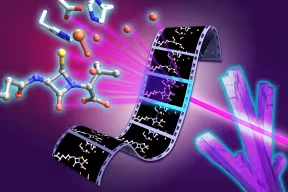
Using X-ray free electron laser experiments, the researchers captured structural snapshots of key intermediates during the reaction that produces penicillin. Image credit: University of Oxford/Greg Stewart/SLAC National Accelerator Laboratory.
<関連情報>
- https://www.ox.ac.uk/news/2026-10-08-ingenious-molecular-movie-finally-reveals-how-penicillin-is-made
- https://www.nature.com/articles/s41929-026-01618-4
時間分解X線自由電子レーザー研究により、イソペニシリンNシンターゼ触媒反応中に予期せぬ中間体が同定された Unanticipated intermediates during isopenicillin N synthase catalysis identified by time-resolved X-ray free-electron laser studies
Patrick Rabe, Hiroki Makita, Rebecca Southwart, Midhun George Thomas, Mihails Kazaks, Shyam Basak, Tiankun Zhou, William K. Myers, Margaret D. Doyle, Philipp S. Simon, Shusaku Hayama, J. Frederick W. Mosselmans, Alexander T. Stead, Abraham O. Oluwole, Malkit Sami, Ian Clifton, Pierre Aller, Asmit Bhowmick, Anthony Tumber, Jos J. A. G. Kamps, Karina Calvopiña, Agata Butryn, Robert Bosman, Arjun Cheema, … Christopher J. Schofield
Nature Catalysis Published:09 October 2026
DOI:https://doi.org/10.1038/s41929-026-01618-4
Abstract
Biosynthesis of penicillin and cephalosporin antibiotics involves the oxidation of the tripeptide δ-(l-α-aminoadipoyl)-l-cysteinyl-d-valine (ACV) to give the conformationally strained bicyclic penicillin ring system, as catalysed by the Fe(II)-dependent oxidase isopenicillin N synthase (IPNS). The structures of the precursors for the sequential β-lactam and thiazolidine ring forming steps in IPNS have remained elusive. Here we studied the reaction of anaerobic IPNS:Fe(II):ACV microcrystals with O2 using time-resolved serial femtosecond crystallography and X-ray emission spectroscopy. High-resolution structures reveal that ACV cysteinyl oxidation produces a thioaldehyde that unexpectedly does not coordinate the iron centre. The use of deuterium-labelled ACV enabled the observation of a monocyclic β-lactam with restoration of the Fe–S bond. Together with mutagenesis, spectroscopic and computational studies, the results support Fe(IV)-mediated penicillin formation involving active-site water molecules. These findings provide structural insight into IPNS catalysis, inform on the wider Fe(II) oxygenase superfamily and highlight the power of X-ray free-electron laser methods for resolving transient enzymatic intermediates.