2026-10-10 中国科学院(CAS)
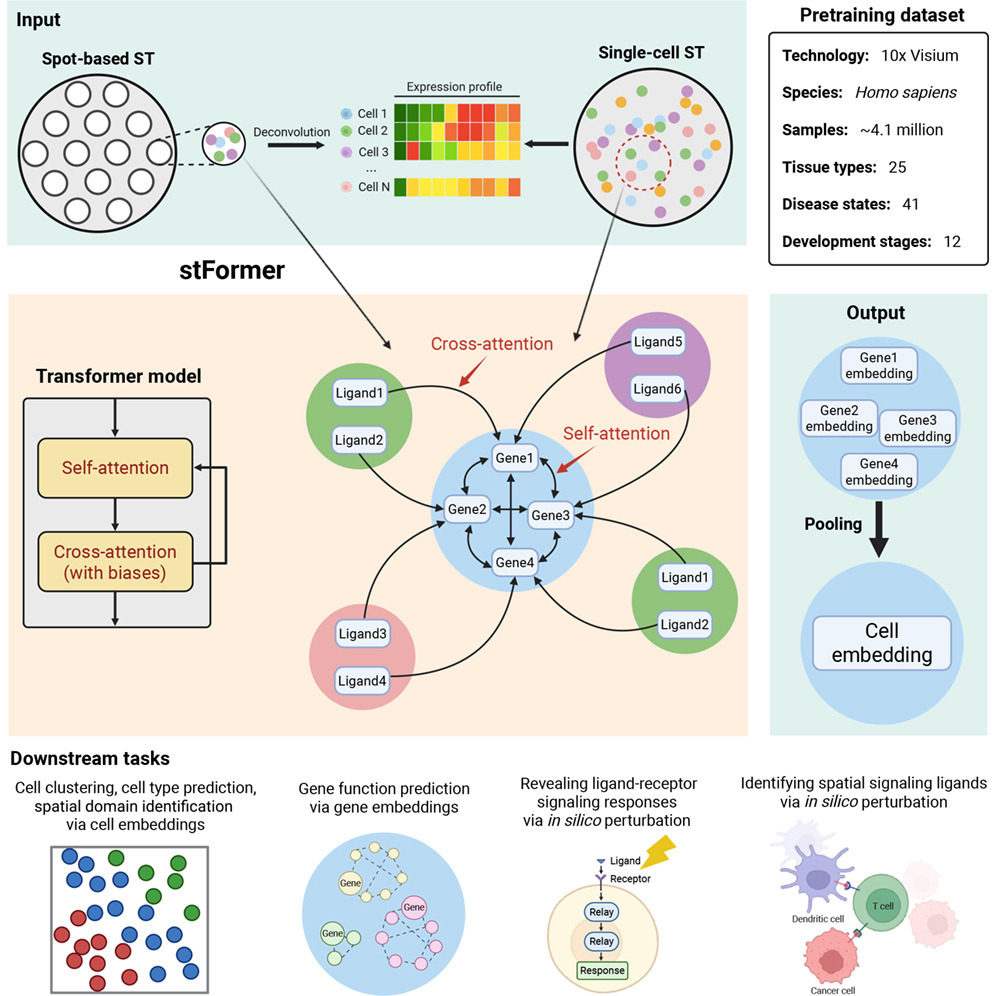
Overview of model architecture, pretraining dataset, and downstream tasks (Image by CAO Shenghao)
<関連情報>
- https://english.cas.cn/newsroom/research-news/202610/t20261012_1202372.shtml
- https://www.cell.com/cell-reports-methods/fulltext/S2667-2375(26)00313-9
stFormerは、空間リガンドシグナル伝達を空間トランスクリプトミクスの基礎モデルに統合します stFormer integrates spatial ligand signaling into a foundation model for spatial transcriptomics
Shenghao Cao ∙ Kaiyuan Yang ∙ Jiabei Cheng ∙ … ∙ Hong-Bin Shen ∙ Xiaoyong Pan ∙ Ye Yuan
Cell Reports Methods Published:September 30, 2026
DOI:https://doi.org/10.1016/j.crmeth.2026.101612
Highlights
- stFormer uses cross-attention to incorporate spatial ligand gene signals
- A biased cross-attention unifies ST platforms across resolution and gene coverage
- Pretrained on ∼4.1 million spatial samples from public human Visium data
- stFormer outperforms scFoundation on clustering, batch correction, and more
Summary
Recent foundation models for single-cell transcriptomic data generate informative, context-aware gene and cell representations. Spatial transcriptomic (ST) data offer extra positional insights but were not considered by these single-cell models. We introduce stFormer, a transformer model tailored for ST data, which employs the cross-attention module to incorporate spatial ligand genes. To unify different ST technologies with a trade-off between resolution and gene coverage, we propose a biased cross-attention method that enables the model to do learning with single-cell resolution on whole-transcriptome but low-resolution Visium data. We assembled a pretraining corpus comprising ∼4.1 million spatial samples from public human Visium datasets. After pretraining, stFormer improved upon the state-of-the-art single-cell foundation model, scFoundation, across diverse tasks, including cell clustering, batch effect correction, cell type prediction, and gene function prediction. stFormer also revealed intercellular ligand-receptor signaling responses via in silico perturbation. Finally, we demonstrated stFormer’s utility in yielding biological findings on two case studies.