2026-10-20 神戸大学
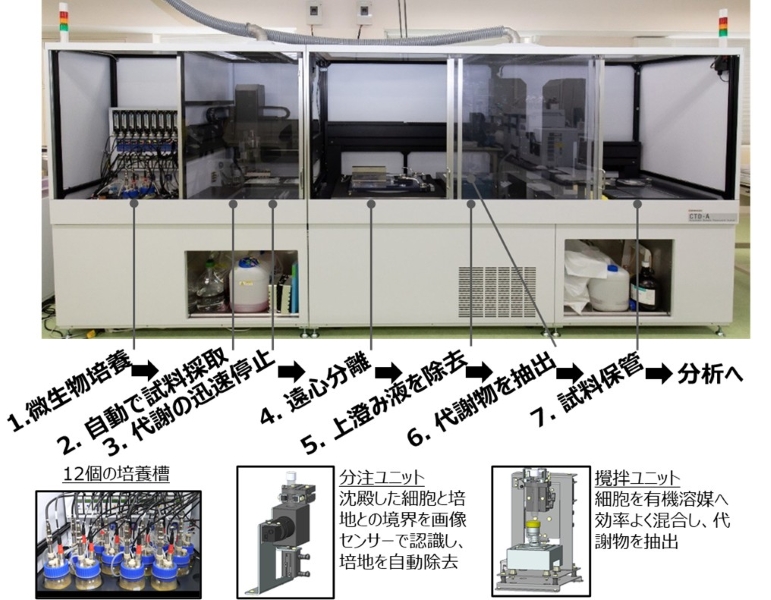
図1 開発した自動メタボローム解析システム
Tanaka et al., Analytical Chemistry(2026)のFigure 1を日本語化・改変。©田中謙也, CC BY
<関連情報>
- https://www.kobe-u.ac.jp/ja/news/article/20261020-68358/
- https://pubs.acs.org/ancham/article/doi/10.1021/acs.analchem.6c01820/5453389/Automated-Quenching-and-Extraction-for-High
高精度メタボロミクスのための自動クエンチングおよび抽出により、大腸菌系統 間で異なるメタボローム軌跡が明らかになる Automated Quenching and Extraction for High-Precision Metabolomics Uncovers Distinct Metabolome Trajectories across Escherichia coli Lineages
Kenya Tanaka;Takahiro Bamba;Musashi Takenaka;Yoshimi Hori;Takanobu Yoshida;Mami Matsuda;Akihiko Kondo;Yoshihiro Hayakawa;Tomohisa Hasunuma
Analytical Chemistry Published:October 19, 2026
DOI:https://doi.org/10.1021/acs.analchem.6c01820
Abstract
Quantitative microbial metabolomics requires rapid quenching and highly standardized extraction, yet these pre-analytical steps remain labor-intensive and difficult to reproduce, limiting time-resolved intracellular measurements under controlled bioreactor cultivation. Here, we present an integrated robotic platform that couples parallel fermenter operation with circulation-based sampling, immediate cold-alcohol quenching, automated refrigerated centrifugation, interface-aware supernatant removal, and solvent extraction with controlled heating and mixing, followed by plate-based storage for liquid chromatography–tandem mass spectrometry (LC–MS/MS). To benchmark the precision of the automated preparation module, we compared repeated LC–MS/MS measurements of a single extract with measurements of independently processed samples subjected to post-quench automated harvesting, extraction, and transfer. The analysis was restricted to 76 analytes consistently detected in all replicates of both datasets. The mean coefficients of variation increased from 6.92% for repeated LC–MS/MS measurements to 8.82% for automated preparation, corresponding to a modest increase of 1.90 percentage points. These results indicate that post-quench automated preparation introduces a small but measurable additional source of variability while maintaining mean analytical variation below 10%. We then performed time-course endo- and exometabolomics across four widely used Escherichia coli lineages (BW25113, BL21(DE3), W, and C). Principal component analysis resolved strain-specific trajectories throughout batch growth and revealed strain-specific metabolic phenotypes, including coordinated accumulation of sugar phosphates and 2-C-methyl-d-erythritol 4-phosphate (MEP) pathway intermediates in strain C, and comparatively high intracellular pools of branched-chain amino acids in strain W. This platform enables standardized and traceable automated preparation for dense, time-resolved metabolomics and provides directly measurable phenotypes for host selection and metabolic engineering.