2026-10-22 北海道大学
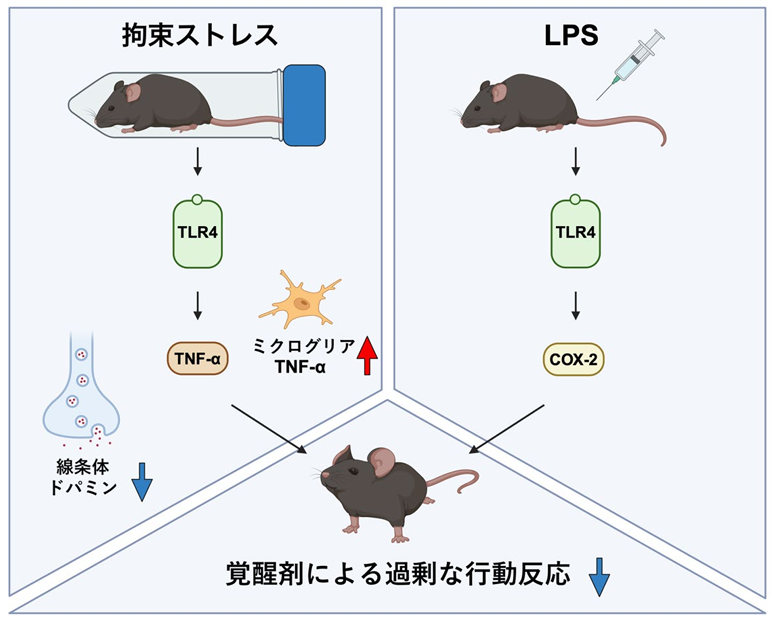
図1.軽度の炎症刺激と急性ストレスによる覚醒剤の過剰反応の抑制機構
<関連情報>
- https://www.hokudai.ac.jp/news/2026/10/post-2477.html
- https://www.hokudai.ac.jp/news/pdf/261022_pr.pdf
- https://bpspubs.onlinelibrary.wiley.com/doi/10.1111/bph.70697
低用量LPS及び急性拘束ストレスは、メタンフェタミン感作雄マウスの行動感作を抑制する Low-dose LPS and acute restraint stress attenuate behavioural sensitisation in methamphetamine-sensitised male mice
Rikuto Christopher Shinohara, Shuhei Ishikawa, Risa Matsumoto, Koki Ito, Mariko Tonosaki, Shiina Matsuyama, Masahiro Ohgidani, Minori Koga, …
British Journal of Pharmacology Published:05 October 2026
DOI:https://doi.org/10.1111/bph.70697
Abstract
Background and Purpose
Clinical observations suggest that acute inflammatory states transiently modulate psychotic symptoms. However, animal models often use relatively strong inflammatory stimuli, and the effects of low-intensity acute inflammation on psychostimulant-induced behavioural sensitisation remain unclear.
Experimental Approach
We examined whether relatively low-intensity acute inflammatory stimuli attenuate behavioural sensitisation in methamphetamine (METH)-sensitised male mice, a model of psychostimulant-induced psychosis. We used a repeated METH (1 mg·kg−1)-sensitised model to evaluate the effects of acute inflammation on behavioural sensitisation. Acute inflammation was induced via two methods: lipopolysaccharides (LPS; 1 μg·kg−1) to mimic peripheral immune activation and restraint stress (RS; single 2-h exposure) to induce an acute stress-related neuroimmune response. LPS doses were adjusted with reference to the magnitude of peripheral cytokine elevation reported in patients, and RS was applied in short single sessions to avoid excessive inflammation.
Key Results
LPS and RS significantly attenuated behavioural sensitisation, without inducing other detectable behavioural abnormalities. The behavioural effects of both LPS and RS were sensitive to toll-like receptor 4 (TLR4) inhibition. LPS-mediated attenuation was sensitive to cyclooxygenase-2 (COX-2) inhibition, whereas RS-mediated attenuation involved tumour necrosis factor-α (TNF-α). TNF-α expression was increased in brain-isolated microglia following RS, and intrastriatal TNF-α reproduced the attenuation of behavioural sensitisation. RS, but not LPS, significantly reduced the striatal extracellular dopamine levels.
Conclusions and Implications
Acute inflammation attenuated METH-induced behavioural sensitisation following low-dose LPS and acute RS. These findings suggest that acute inflammation may modulate processes relevant to METH-induced psychosis and highlight TNF-α as a candidate for further investigation.