2026-10-23 国立がん研究センター,京都大学,名古屋大学,近畿大学,がん研究会
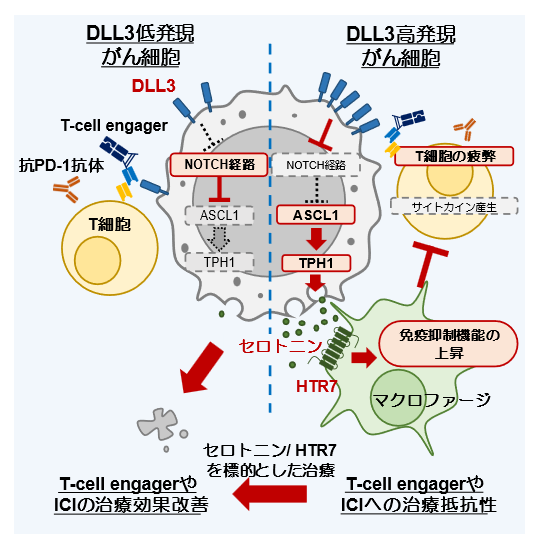
図1 本研究で明らかになった肺神経内分泌がんが免疫細胞の働きを抑える仕組み
<関連情報>
- https://www.ncc.go.jp/jp/information/pr_release/2026/1023/index.html
- https://www.sciencedirect.com/science/article/abs/pii/S1535610826004356
肺神経内分泌癌はセロトニンを介して免疫抑制性マクロファージを誘導し、T細胞エンゲージャーであるタルラタマブに対する耐性を引き起こす Lung neuroendocrine cancer induces immunosuppressive macrophages via serotonin to drive resistance to the T cell engager tarlatamab
Kotaro Nomura, Tomoyo Fukami, Shinichiro Kato, Shunya Tanaka, Akito Fukuda, Yuki Koike, Masaki Kondo, Kazuhiro Kumagai, Takuma Irie, Genki Okumura, Tetsuro Taki, Shingo Sakashita, Masayuki Shirasawa, Tatsuya Yoshida, Kouya Shiraishi, Ryo Ariyasu, Yuki Takeyasu, Takahiro Niimi, Tetsuya Sakai, Masahiro Torasawa, …,Hiroyoshi Nishikawa
Cancer Cell Available online: 22 October 2026
DOI:https://doi.org/10.1016/j.ccell.2026.09.016
Highlights
- DLL3high neuroendocrine lung cancers produce serotonin via TPH1 induction
- Tumor-derived serotonin activates immunosuppressive HTR7+ macrophages
- The serotonin-HTR7 axis impairs TCE-induced CD8+ T cell immunity
- Targeting TPH1 or HTR7 restores sensitivity to TCEs and PD-1 blockade
Summary
Tarlatamab, a delta-like protein 3 (DLL3) × CD3-directed T cell engager (TCE), provides clinical efficacy against small cell lung cancers (SCLCs), although its efficacy remains limited, indicating the importance of clarifying the resistance mechanisms. We show that serotonin (5-HT) produced by DLL3high neuroendocrine cancers (NECs) induces immunosuppressive tumor-associated macrophages (TAMs), resulting in impaired CD8+ T cell function and TCE resistance. Using SCLC and large cell neuroendocrine carcinoma cohorts, we find that DLL3high SCLCs induce immunosuppressive TAMs in the tumor microenvironment and become resistant to tarlatamab. DLL3high NECs increase 5-HT production via TPH1 upregulation. NEC-derived 5-HT augments the immunosuppressive activity of 5-HT receptor 7 (HTR7)-expressing TAMs. Genetic ablation of HTR7 in TAMs or TPH1 in NECs restores CD8+ T cell function and improves the efficacy of TCEs and programmed cell death protein 1 (PD-1) blockade. We propose that NEC-derived 5-HT-HTR7 axis drives immunosuppressive TAM activation and TCE resistance, making it a key target to increase TCE efficacy.