2026-11-11 東北大学
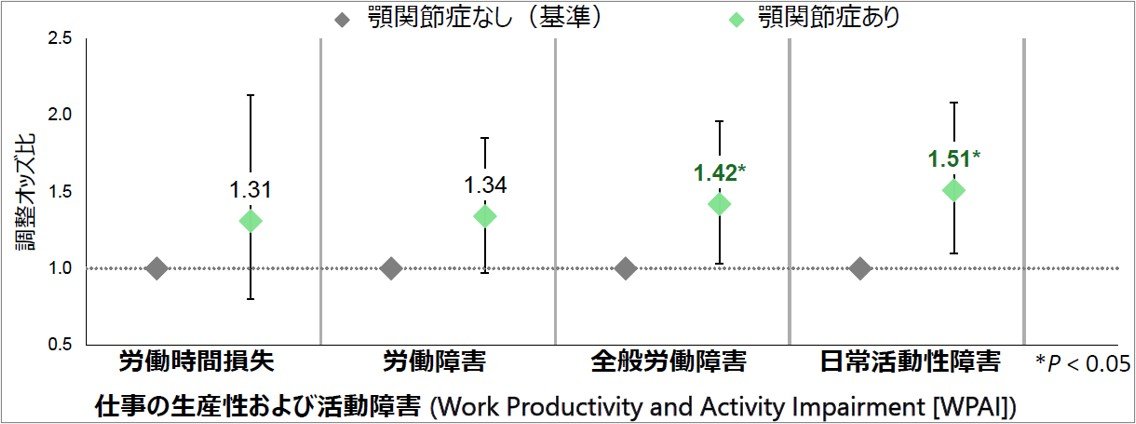
図1. 顎関節症の診断と仕事の生産性・活動障害との関連(調整オッズ比) 全般労働障害のオッズ比:1.42、日常活動性障害のオッズ比:1.51
<関連情報>
- https://www.tohoku.ac.jp/japanese/2026/11/press20261111-02-impairment.html
- https://onlinelibrary.wiley.com/doi/10.1111/joor.70360
顎関節症、労働生産性、および活動障害:日本の診療報酬請求および調査データベースを用いたコホート研究 Temporomandibular Disorders, Work Productivity, and Activity Impairment: A Cohort Study Using a Claims and Survey Database in Japan
Manami Hoshi-Harada, Taro Kusama, Yudai Tamada, Ken Osaka, Kenji Takeuchi
Journal of Oral Rehabilitation Published: 04 November 2026
DOI:https://doi.org/10.1111/joor.70360
Abstract
Background
Temporomandibular disorders (TMDs) are prevalent musculoskeletal conditions worldwide. However, their societal and productivity burden remains poorly understood.
Objective
Using a claims and survey database, this 3-year cohort study investigated the association between TMD diagnosis and work productivity and activity impairment (WPAI) among Japanese workers.
Methods
We identified TMD diagnoses (exposure) using claims data and assessed the WPAI (outcome) using a validated questionnaire. A two-part model was used to examine the association between TMD diagnosis around the survey period and WPAI outcomes. The first part employed a logistic regression model to estimate the odds ratio (OR) and 95% confidence interval (CI) for impairments in WPAI outcomes. The second part utilized a generalized linear model with a gamma distribution and a log-link function to estimate the exponentiated coefficients (mean ratio) and 95% CI for the magnitude of impairment among those reporting impairment in WPAI outcomes.
Results
The analysis included 18 570 participants (mean age: 49.0 [standard deviation = 9.1] years; 65.7% male). After adjusting for all covariates, workers with TMD showed higher odds of impairment across all WPAI indicators than those without (OR: absenteeism, 1.31 [95% CI, 0.80–2.13]; presenteeism, 1.34 [0.97–1.85]; overall work impairment, 1.42 [1.03–1.96]; and activity impairment, 1.51 [1.10–2.08]). Among workers reporting any impairment in WPAI outcomes, TMD was not associated with WPAI severity.
Conclusion
Workers with TMD diagnosis more often reported overall work and activity impairments. The observed association may inform future research on the impact of TMD on WPAI outcomes.