2026-11-12 リンショーピング大学
<関連情報>
- https://liu.se/en/news-item/organ-on-chip-shows-how-cancer-interacts-with-its-surroundings
- https://doi.org/10.1073/pnas.2602541123
ヒト頭頸部扁平上皮癌の腫瘍微小環境を再現する神経・血管統合型オルガン・オン・チップモデル(An innervated and vascularized HNSCC-on-a-chip model built on defined and tunable engineered extracellular matrices)
Alessia Maria Pignataro, Cornelia Christina Schwarz, Emilia Wiechec, Alessandro Cordiale, Shyama Sasikumar, Alexander Jenssen, Taka Ariyaberg, Lalit Pramod Khare, Ehsanul Hoque Apu, Karin Roberg, Sajjad Naeimipour, Gabriela Basile Carballo, Marcin Szczot, Daniel Aili, Marco Rasponi, Pierfrancesco Pagella
Proceedings of the National Academy of Sciences (PNAS), 123(44), e2602541123:2026-10-27
DOI:10.1073/pnas.2602541123
Copyright © 2026 the Author(s). Published by PNAS. This open access article is distributed under Creative Commons Attribution License 4.0 (CC BY).
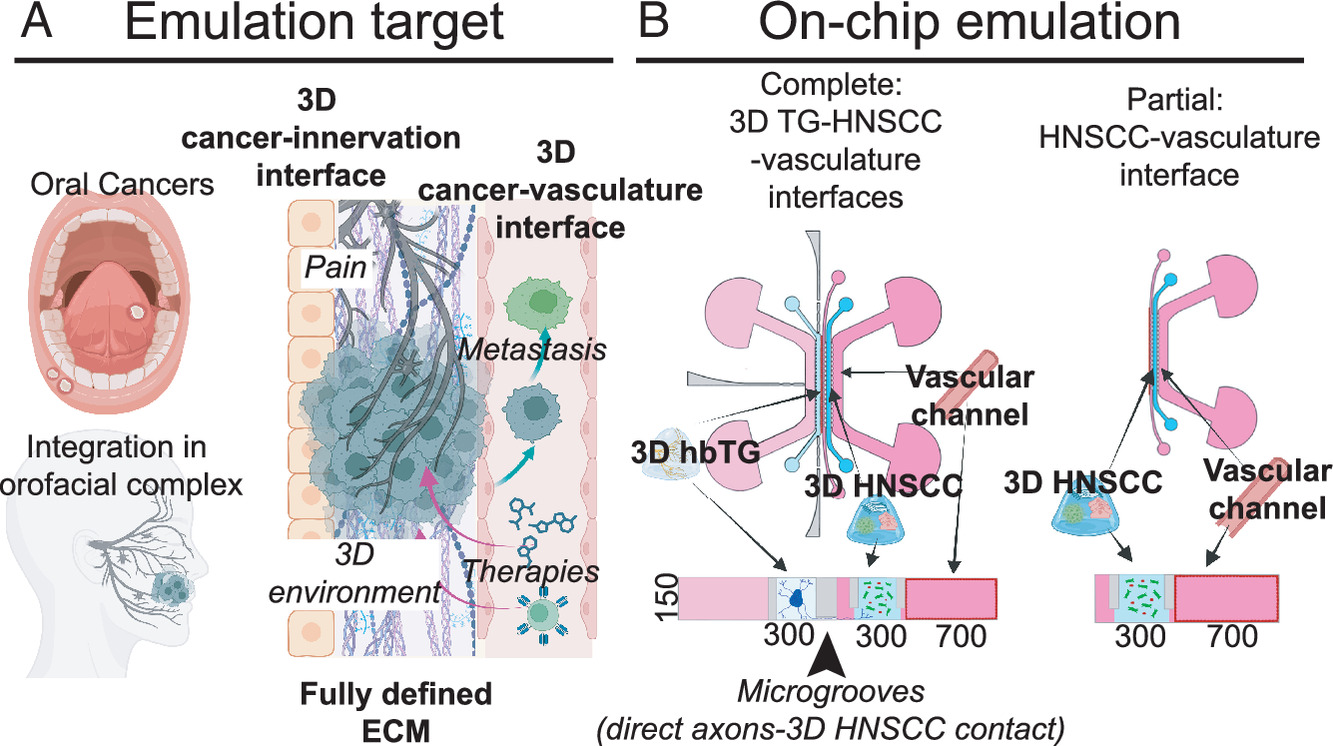
Cancer progression, invasion, and therapeutic resistance are strongly influenced not only by the intrinsic properties of cancer cells but also by their interactions with the extracellular matrix (ECM), blood vessels, and nerves. However, conventional in vitro models have struggled to reproduce these components of the tumor microenvironment simultaneously. In this study, researchers developed an innervated and vascularized organ-on-a-chip model of human head and neck squamous cell carcinoma (HNSCC), using engineered extracellular matrices (eECMs) with precisely defined and tunable properties. The platform was constructed stepwise by combining patient-derived cancer cells, cancer-associated fibroblasts, and endothelial cells, followed by the integration of a vascular interface and human bioengineered trigeminal ganglia derived from stem cells. The researchers demonstrated that ECM composition and properties influence cancer-cell transcriptional states, multicellular self-organization, cisplatin sensitivity, and directional collective migration and invasion toward blood vessels. They also observed that tumors in contact with nerves were less likely to invade blood vessels but grew larger. This human-based platform provides a controlled experimental system for investigating interactions among cancer cells, extracellular matrices, vasculature, and innervation. The findings offer new opportunities for understanding tumor progression, drug screening, and evaluating treatment responses, while potentially reducing reliance on animal models.