2026-08-26 東北大学
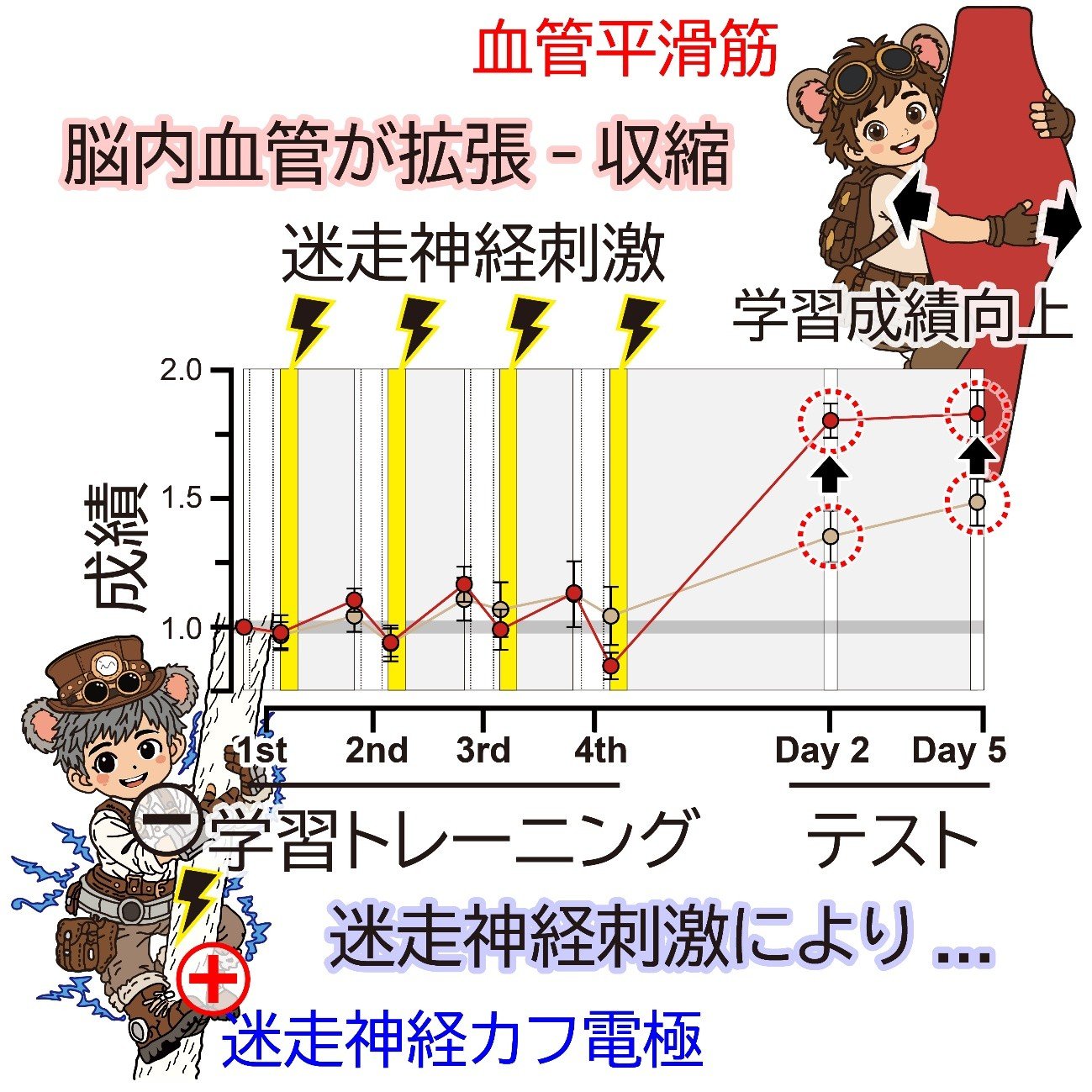
図1. 迷走神経刺激による学習成績向上の概要。
<関連情報>
- https://www.tohoku.ac.jp/japanese/2026/08/press20260826-02-VNS.html
- https://www.cell.com/iscience/fulltext/S2589-0042(26)02791-4
迷走神経刺激は血管振動を誘発し、長期学習を促進する Vagal nerve stimulation induces vascular oscillations and enhances long-term learning
Junyu U. Chen (陳俊宇) ∙ Yoko Ikoma (生駒葉子) ∙ Ko Matsui (松井広)
iScience Published:August 25, 2026
DOI:https://doi.org/10.1016/j.isci.2026.117413
Highlights
- Vagus nerve stimulation enhances multi-day motor learning in mice
- VNS induces transient vascular volume dynamics in the cerebellar flocculus
- The magnitude of vascular oscillations is associated with learning performance
- VNS-enhanced learning may involve coordinated vascular and metabolic regulation
Summary
Despite its rapid emergence as a powerful approach for probing peripheral modulation of brain function, vagus nerve stimulation (VNS) is primarily understood through neuromodulatory pathways, leaving the potential contribution of vascular dynamics largely unexplored. Here, we examined whether VNS influences learning performance and its relationship with cerebrovascular dynamics using a chronic cuff-electrode system in freely moving mice. Using a cerebellum-dependent horizontal optokinetic response (HOKR) paradigm, we show that post-training VNS selectively enhances long-term learning. In parallel, in vivo fiber photometry reveals that VNS induces transient vascular fluctuations that evolve into oscillatory dynamics across repeated stimulation. The magnitude of these oscillations is increased by VNS and correlates with multi-day learning performance. These findings suggest that, in addition to neuromodulatory mechanisms, vascular dynamics may represent an underappreciated component of learning-related brain function. VNS-induced vascular oscillations are associated with multi-day learning, providing a new perspective on how peripheral signals influence central brain function.