2026-08-31 東北大学
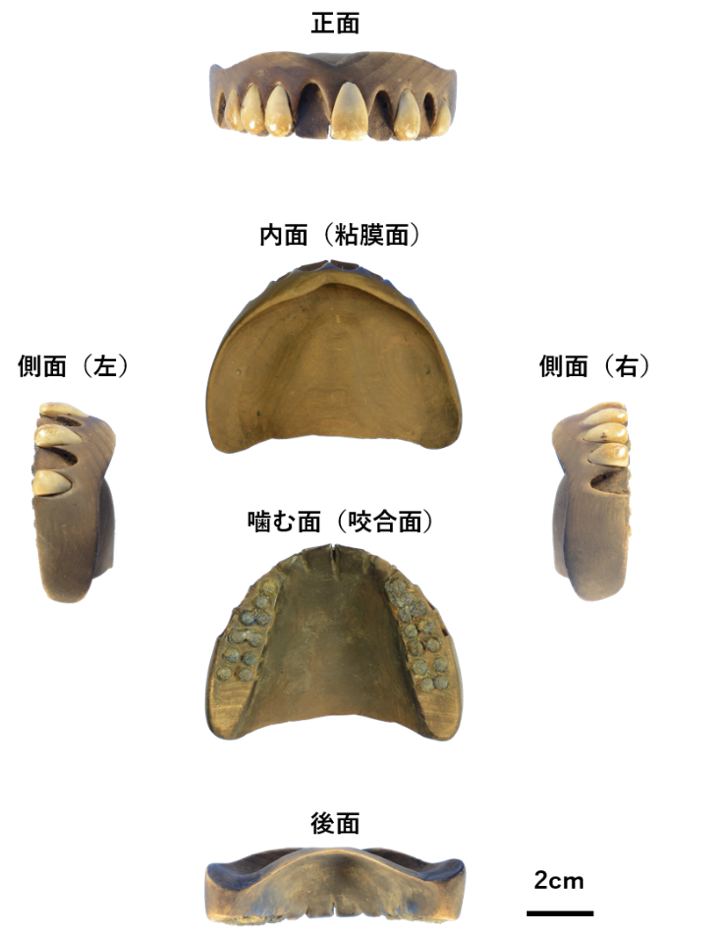
図1. 本研究で用いた江戸時代木床義歯の一例(D879-1)
<関連情報>
- https://www.tohoku.ac.jp/japanese/2026/08/press20260831-04-denture.html
- https://onlinelibrary.wiley.com/doi/10.1002/oa.70159
江戸時代の木製義歯と日本の上顎骨の形態学的類似性:相同モデルを用いた三次元解析 Morphological Similarity Between Edo-Period Wooden Dentures and Maxillae in Japan: A Three-Dimensional Analysis Using Homologous Modeling
Kie Yoshida, Yuka Hatano, Moe Kosaka, Toshihiko Suzuki
International Journal of Osteoarchaeology Published: 09 August 2026
DOI:https://doi.org/10.1002/oa.70159
ABSTRACT
Wooden dentures represent a distinctive form of dental technology uniquely developed in Japan that is no longer in clinical use. Although Edo-period (1603–1867) wooden dentures are presumed to have achieved sufficient precision, their morphological fit has not been quantitatively evaluated. This study aimed to examine the morphological similarity between edentulous maxillae and wooden maxillary complete dentures and assessed the feasibility of identifying denture wearers. Sixteen edentulous maxillae and three wooden maxillary complete dentures excavated from the Edo-period Koun-ji Temple site in Tokyo were analyzed. Three-dimensional surface morphologies were digitized and converted into homologous models. Principal component analysis (PCA) and maxilla–denture distance analysis were conducted after digital superimposition. In PC1–PC2 scatter plots, correct maxillae–denture pairs clustered closely and were separated from incorrect pairings. Maxilla–denture distances for correct pairs were predominantly 2–6 mm and significantly smaller than those of incorrect pairings (p < 0.05). The mean histogram intersection similarity for correct pairs was 0.668. Combined PCA and maxilla–denture distance analysis enabled quantitative evaluation of morphological fit and supported the potential of wooden dentures for personal identification in osteoarchaeological contexts. This study also presents the first quantitative evidence of morphological correspondence between Edo-period wooden dentures and edentulous maxillae.