2025-08-27 ペンシルベニア州立大学(PennState)
<関連情報>
- https://www.psu.edu/news/research/story/ancient-dna-reveals-farming-spread-through-migration-locals-slow-adopt-it
- https://www.nature.com/articles/s41467-025-63172-0
ヨーロッパ新石器時代拡大のモデル化は、集団内交配の優位性と限定的な文化伝播を示唆する Modeling the European Neolithic expansion suggests predominant within-group mating and limited cultural transmission
Troy M. LaPolice,Matthew P. Williams & Christian D. Huber
Nature Communications Published:25 August 2025
DOI:https://doi.org/10.1038/s41467-025-63172-0
Abstract
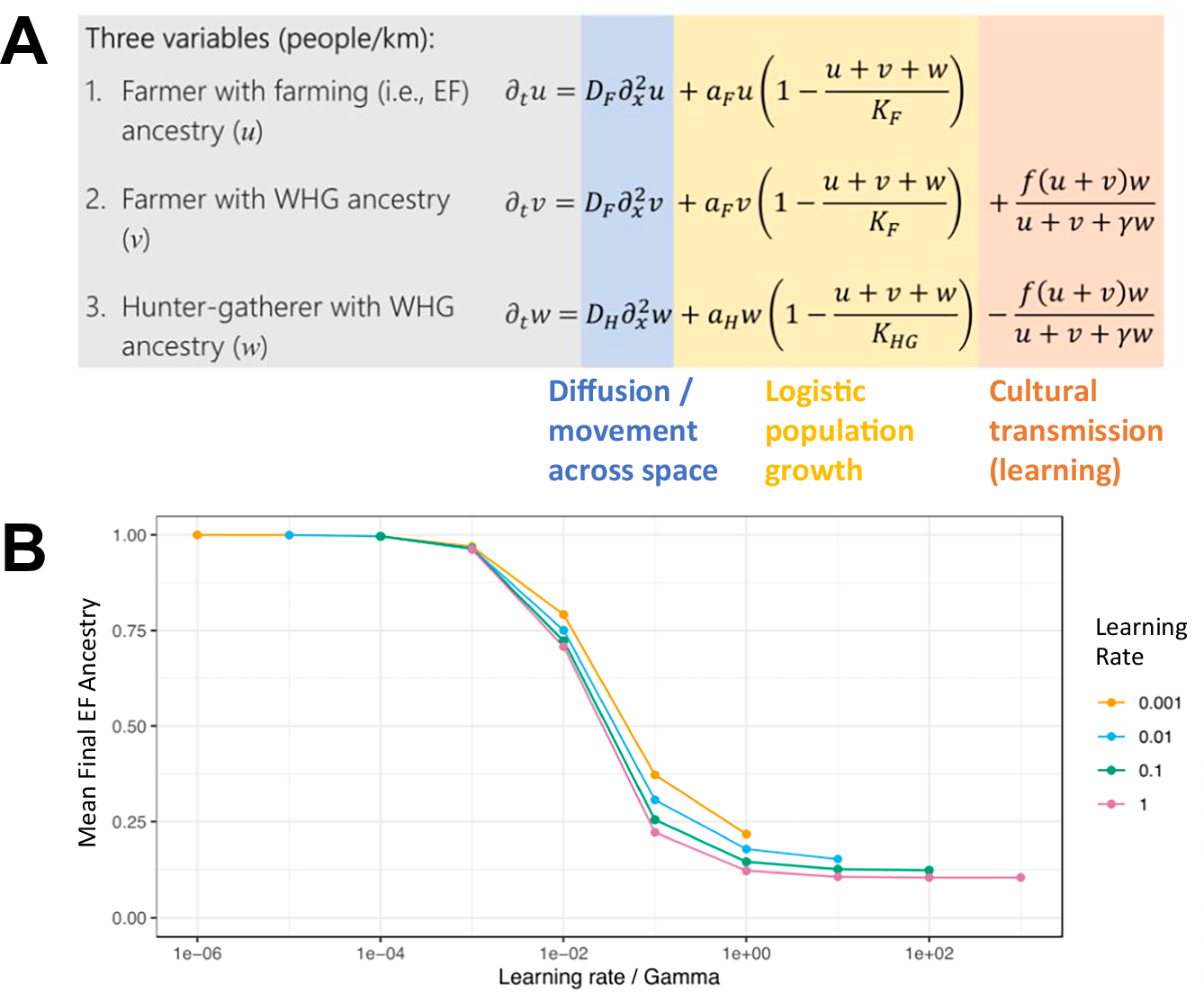
The Neolithic Revolution initiated a pivotal change in human society, marking the shift from foraging to farming. Historically, the underlying mechanisms of agricultural expansion have been a topic of debate, centered around two primary models: cultural diffusion, involving the transfer of knowledge and practices, and demic diffusion, characterized by the migration and replacement of populations. More recently, ancient DNA analyses have revealed significant ancestry changes during Europe’s Neolithic transition, suggesting a primarily demic expansion. Nonetheless, the presence of 10-15% hunter-gatherer ancestry in modern Europeans indicates cultural transmission and between-group mating were additional contributing factors. Here, we integrate mathematical models, agent-based simulations, and ancient DNA analysis to dissect and quantify the roles of cultural diffusion and between-group mating in farming’s expansion. Our findings indicate limited cultural transmission and predominantly within-group mating. Additionally, we challenge the assumption that demic expansion always leads to ancestry turnover. These results offer insights into early agricultural society through the integration of ancient DNA with archaeological models.