2026-02-27 ペンシルベニア州立大学(Penn State)
<関連情報>
- https://www.psu.edu/news/eberly-college-science/story/protein-regulator-sugars-and-fats-may-work-unexpected-parter-itself
- https://academic.oup.com/nar/article/54/4/gkag087/8494765
DNAはファルネソイドX受容体の非典型的な二量体形成を誘導する DNA induces non-canonical dimerization of the farnesoid X receptor
Sabab Hasan Khan,Neela Yennawar,C Denise Okafor
Nucleic Acids Research Published:23 February 2026
DOI:https://doi.org/10.1093/nar/gkag087
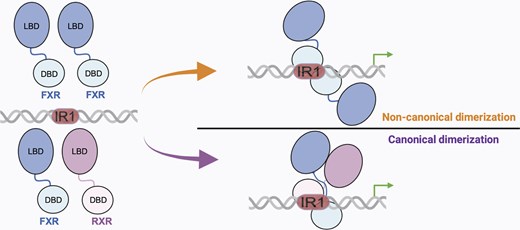
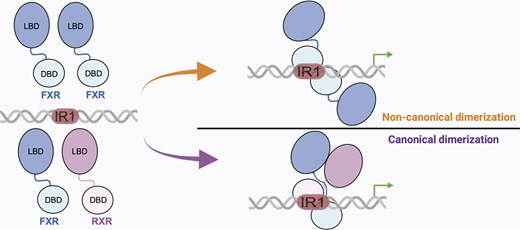
Graphical Abstract
Abstract
The farnesoid X receptor (FXR) is a ligand-regulated transcription factor that primarily functions as an obligate heterodimer with retinoid X receptor alpha (RXRα). While evidence suggests that FXR can also bind DNA independently, the nature of this interaction and the characteristics of the resulting complex remain unknown. Using purified multidomain FXR containing the DNA and ligand binding domains linked by the hinge, we present the first biophysical and structural characterization of FXR bound to DNA independently of RXR. Our findings reveal that DNA binding promotes the assembly of two FXR monomers into a complex capable of binding coregulators and activating transcription from an FXR DNA binding motif. By comparing the FXR-DNA complex with the multidomain FXR-RXRα heterodimer, we uncover key structural and functional differences between the complexes. Small-angle X-ray scattering (SAXS) analysis shows that the FXR-DNA complex adopts a uniquely extended conformation, in which the two ligand-binding domains are non-interacting, with a dimer interface on the DNA-binding domains. By characterizing this newly identified oligomeric state of FXR, our study reveals a novel architectural motif with broad implications for its transcriptional function.