2026-02-27 横浜市立大学
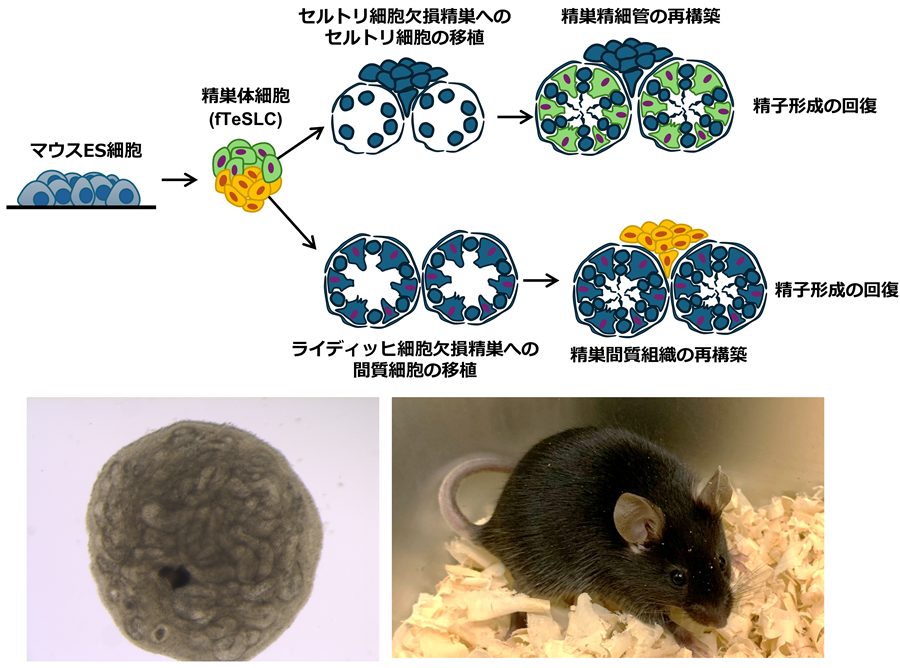
図1 本研究の概要
マウス多能性幹細胞(ES細胞)から、精巣を構成する主要な体細胞(セルトリ細胞・ライディッヒ前駆細胞)を誘導。これを体細胞欠損モデルマウスへ移植することで、精子形成を支える組織構造(精細管*3(左下写真)・間質*4)の再構築に成功した。その結果、停止していた精子形成が再開し、得られた精子細胞を用いた顕微授精により、健康な産子を獲得した(右下写真)。
<関連情報>
- https://www.yokohama-cu.ac.jp/res-portal/news/20260227sato_sci_adv.html
- https://www.science.org/doi/10.1126/sciadv.adz0269
多能性幹細胞から機能的に適格な精巣体細胞を生成する Generation of functionally competent testicular somatic cells from pluripotent stem cells
Takuya Sato, Takashi Yoshino, Mai Ohtsuka, Takahiro Suzuki, […] , and Takehiko Ogawa
Science Advances Published:26 Feb 2026
Abstract
Cellular interactions between germ cells and gonadal somatic cells are essential for the progression of gametogenesis. Here, we report a culture method for generating fetal testicular somatic cell–like cells (fTeSLCs) from embryonic stem cells. These fTeSLCs exhibit a transcriptomic profile closely resembling that of their in vivo counterparts, including distinct cell populations corresponding to Sertoli cells and interstitial cells. For functional assessment, interstitial cell–like cells (ICLCs) and Sertoli-like cells (SerLCs) were isolated from fTeSLCs. ICLCs differentiated into Leydig cells when cocultured with testes lacking endogenous Leydig cells, thereby restoring androgenic support. SerLCs reconstituted the seminiferous epithelium following selective ablation of endogenous Sertoli cells. Both cell types supported spermatogenesis and generated spermatids reaching the elongating stage. Notably, round spermatids derived from these reconstructed systems produced viable offspring by round spermatid injection. These findings demonstrate that fTeSLCs can generate functional testicular somatic cells, providing a valuable platform for studying testis development and spermatogenesis.