2026-03-05 東北大学
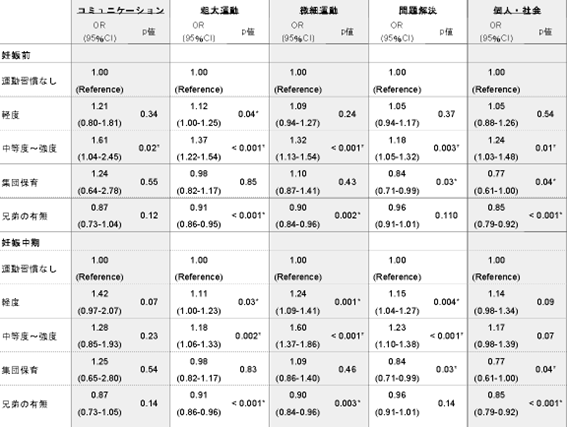
図1. 6か月児のASQ-3領域別の多変量解析の結果
妊娠前では母体の活動レベルが高いほど神経発達が良く、妊娠中期では特に粗大運動、微細運動、問題解決の領域で有意な関連がみられました。
<関連情報>
- https://www.tohoku.ac.jp/japanese/2026/03/press20260305-03-pregnancy.html
- https://www.tohoku.ac.jp/japanese/newimg/pressimg/tohokuuniv-press20260305_web03_pregnancy.pdf
- https://jamanetwork.com/journals/jamanetworkopen/fullarticle/2845770
妊娠前および妊娠中の身体活動と幼児期の神経発達 Physical Activity Before and During Pregnancy and Neurodevelopment in Early Childhood
Io Kumasaka, MD; Tomohisa Suzuki, MD, PhD; Keita Kanamori, MD, PhD;et al
JAMA Network Open Published:March 3, 2026
DOI:10.1001/jamanetworkopen.2026.0345
Key Points
Question How is maternal physical activity before and during pregnancy associated with neurodevelopment in children?
Findings In this cohort study involving 38 219 mother-child pairs, maternal physical activity before and during pregnancy was associated with neurodevelopmental outcomes in late infancy. Moreover, higher levels of maternal exercise were associated with more favorable neurodevelopmental outcomes.
Meaning These findings suggest that maternal physical activity before and during pregnancy may be associated with optimized early neurodevelopment in offspring, particularly regarding motor function, highlighting the potential benefits of prenatal exercise beyond maternal health.
Abstract
Importance Prenatal maternal exercise is recognized for its benefits to both mother and child. However, research examining how maternal physical activity influences the neurodevelopment of offspring is limited.
Objective To investigate the association between maternal physical activity before and during pregnancy and neurodevelopmental outcomes in children.
Design, Setting, and Participants This cohort study analyzed data from the Japan Environment and Children’s Study, a nationwide birth cohort funded by the Ministry of the Environment in Japan. Mother-child pairs were recruited and enrolled between January 24, 2011, and March 31, 2014, with child follow-up from birth to 3 years of age. Of 104 062 records, 65 843 were excluded due to missing data or guideline-based criteria, resulting in 38 219 mother-child pairs included in the analysis. The present analysis was conducted between June 24, 2024, and June 30, 2025.
Exposures Maternal physical activity levels were assessed before and during pregnancy using the International Physical Activity Questionnaire.
Main Outcomes and Measures Child neurodevelopment was assessed using the Ages and Stages Questionnaires, Third Edition, at 6-month intervals from 6 months to 3 years of age. Five developmental domains were evaluated: communication, gross and fine motor skills, problem solving, and personal-social. Scores were based on caregiver responses and compared with established cutoff scores.
Results Among the 38 219 mother-child pairs (maternal mean [SD] age, 31.1 [4.8] years; 19 429 [50.8%] male children), multivariable logistic regression showed that higher maternal physical activity was associated with child neurodevelopment. Higher prepregnancy activity was associated with significantly higher odds for each ASQ-3 domain at 6 months of age and higher midpregnancy activity with high odds for the gross motor (odds ratio [OR], 1.18; 95% CI, 1.06-1.33), fine motor (OR, 1.60; 95% CI, 1.37-1.86), and problem solving (OR, 1.23; 95% CI, 1.10-1.38) domains. Higher prepregnancy activity was associated with higher odds for the problem-solving domain (OR, 1.16; 95% CI, 1.01-1.34) at 3 years of age; there was no association with any other domain. Higher midpregnancy activity was not associated with higher odds of any ASQ domain at 3 years of age.
Conclusions and Relevance In this cohort study of mother-child pairs, maternal physical activity before and during pregnancy was associated with child neurodevelopment, particularly for motor function between 6 months and 1 year of age. Further investigations are required to find the physiological mechanisms explaining how maternal physical activity affects child neurodevelopment.