2026-03-16 ミュンヘン大学(LMU)
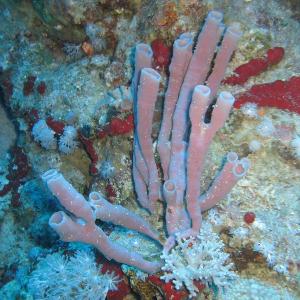
Callyspongia siphonella, a sponge species endemic to the Red Sea. | © Gert Wörheide
<関連情報>
- https://www.lmu.de/en/newsroom/news-overview/news/sponges-in-the-indo-pacific-a-hotspot-of-endemism-3ca74750.html
- https://onlinelibrary.wiley.com/doi/10.1111/jbi.70171
バーコード法によるインド太平洋浅海域海綿動物の生物多様性の推定 Barcoding-Inferred Biodiversity of Shallow-Water Indo-Pacific Demosponges
Dirk Erpenbeck, Adrian Galitz, Michael L. Berumen, Gabriele Büttner, Cécile Debitus, Moritz Dirnberger, Merrick Ekins, Kathryn Hall, Leonard Namuth, Sylvain Petek, Neda Rahnamae, …
Journal of Biogeography Published: 16 March 2026
DOI:https://doi.org/10.1111/jbi.70171
ABSTRACT
Aim
The Indo-Pacific is the world’s largest marine biogeographic region. It is characterised by different degrees of connectivity among its subregions and harbours the majority of demosponge species currently known to science. Comparisons between regional sponge faunas have been undertaken in the past, mostly based on morphological species identification. The Sponge Barcoding Project, in tandem with regional DNA taxonomy campaigns, provides one of the largest DNA-based taxonomic data collections from sponges of the Indo-Pacific. Here, we utilise the barcoding data in the most extensive molecular biodiversity study of sponges to date, which reveals patterns of shallow-water demosponge faunal connectivity, endemism and distribution in the Indo-Pacific with a level of resolution unavailable in prior morphology-based studies.
Location
Demosponge specimens in this study cover 13 marine provinces (MPs) of the Indo-Pacific.
Methods
We classified demosponge barcodes from 1910 sponge samples into 701 molecular operational taxonomic units (MOTUs) using 28S rRNA. MOTU composition of the MPs was compared based on Jaccard and Sørenson dissimilarities and other biodiversity indices.
Results
Our data corroborated high endemism in MPs (up to 84.1% endemic MOTUs). Faunal overlaps are between the Red Sea and the Gulf, which displayed small connectivity with other MPs in the Western Indian Ocean. The Western Indian Ocean is a strong faunistic boundary to the Central Indo-Pacific, to which the Polynesian sponge faunas were comparatively isolated as well.
Main Conclusions
Our data corroborate case studies on sponges that generally reject the presence of cosmopolitan or otherwise widespread sponge species, instead revealing high levels of regional endemism. This is consistent with similar observations and hypotheses in other marine invertebrates, and highlights the need for close regional monitoring to identify biodiversity changes. Connectivity among Indo-Pacific MPs differs for demosponges in many aspects from that of other marine taxa, hypothetically due to their shorter pelagic larval phase.