
2026-03-23 中国科学院(CAS)
中国科学院西双版納熱帯植物園(XTBG)の研究チームは、乾季のある熱帯林でツル植物(リアナ)が樹木より優勢となる理由を、花の水分輸送戦略の違いから解明した。32種のBauhinia属を比較した結果、リアナは高密度の葉脈や気孔を持つ強固な花構造により乾燥耐性を高め、「耐乾燥型」戦略で高温・乾燥環境でも開花可能。一方、樹木は水分貯蔵に依存する「回避型」で乾燥耐性は低い。また、水輸送効率と安全性のトレードオフも両者で異なり、繁殖器官レベルで明確な戦略分化が確認された。これにより、気候変動下でリアナが拡大する生態学的要因が示された。
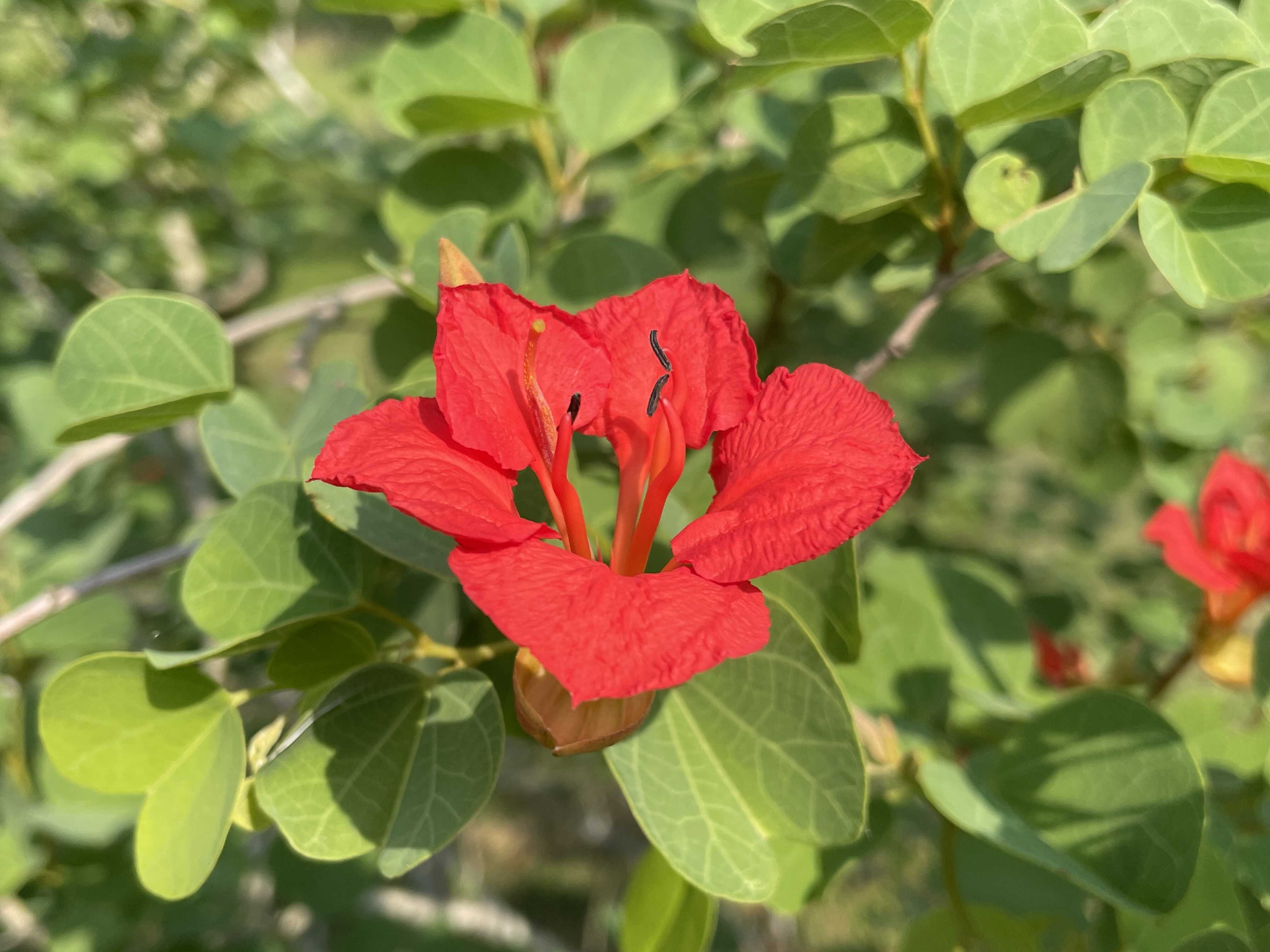
Flower of Bauhinia plants. (Image by KE Yan)
<関連情報>
- https://english.cas.cn/newsroom/research-news/202603/t20260324_1153247.shtml
- https://nph.onlinelibrary.wiley.com/doi/10.1111/nph.71103
バウヒニア属における多様な花の水分輸送戦略:つる植物は干ばつ耐性を獲得する一方、樹木は干ばつ回避を優先する Divergent floral hydraulic strategies in Bauhinia s.l.: lianas adopt drought tolerance while trees prioritize drought avoidance
Yan Ke, Yun-Bing Zhang, Yi-Yuan Du, Xian-Yan Huang, Feng-Jiao Liu, Shi-Hua Qi, Xiang-Wen Fang, Yong-Jiang Zhang, Adam B. Roddy, Jiao-Lin Zhang
New Phytologist Published: 17 March 2026
DOI:https://doi.org/10.1111/nph.71103
Summary
- Lianas are particularly abundant in seasonally dry tropical forests, where most species flower during the dry season. While hydraulic differences of vegetative organs between lianas and trees are well-documented, floral hydraulic strategies and their potential role in liana expansion remain unclear.
- To characterize divergence in floral water-use strategies between lianas and trees, we examined 24 floral traits related to water transport, storage, drought tolerance, and pollinator attraction in 16 liana and 16 tree species of Bauhinia s.l. from a tropical seasonal rainforest in Yunnan, China.
- Liana flowers exhibited greater petal vein density, stomatal density and size, flower mass per area, and drought tolerance than tree flowers, which showed higher saturated water content and hydraulic capacitance. Liana flowers exhibited a trade-off between hydraulic efficiency and safety, but trees did not. Life forms also differed in trait coordination linking hydraulic structure, function, and reproduction.
- Our findings reveal divergent floral hydraulic syndromes: lianas adopt structurally reinforced, drought-tolerant designs for canopy flowering under high vapor pressure deficit, while trees rely on internal water reserves to buffer water loss. This study provides the first organ-level evidence that divergent floral hydraulic strategies underpin reproductive success and may help explain liana dominance in seasonally dry tropical forests under climate change.
